
Relevant Backlinks: Why Link Relevance Matters for SEO

What Relevance Means for a Backlink
A backlink is a link from one page to another [2], and relevance describes how closely the referring page, its content, and its audience match your page. A link from an article about content marketing to your guide on link building makes sense; a link from a general news site to the same guide carries less context, even when the news site is far more popular. Search engines use links among the signals that decide which pages deserve visibility [1], and relevance is what keeps that signal meaningful.
Relevance is not one thing but three layers that stack: the site level, the page level, and the content and audience level. A link can pass one layer and fail another, so the evaluation separates them. The pillar guide to high-quality backlinks treats relevance as the first filter in the full framework, before authority and placement.
Site-Level Relevance: The Domain’s Topic
Site-level relevance is whether the referring domain, as a whole, operates in your space. A marketing blog linking to a marketing guide is site-relevant; a directory that collects unrelated industries is not, even when the page happens to mention your topic. The domain’s topic sets the ceiling for how meaningful any link from it can be.
Judge site-level relevance by the mix of content the domain publishes, not by its name or its category. A personal blog that occasionally covers SEO is different from a site whose entire archive is about search marketing, and the evaluation should reflect that. When the site covers many topics, the page-level context matters more than the domain label.
Page-Level Relevance: The Context Around the Link
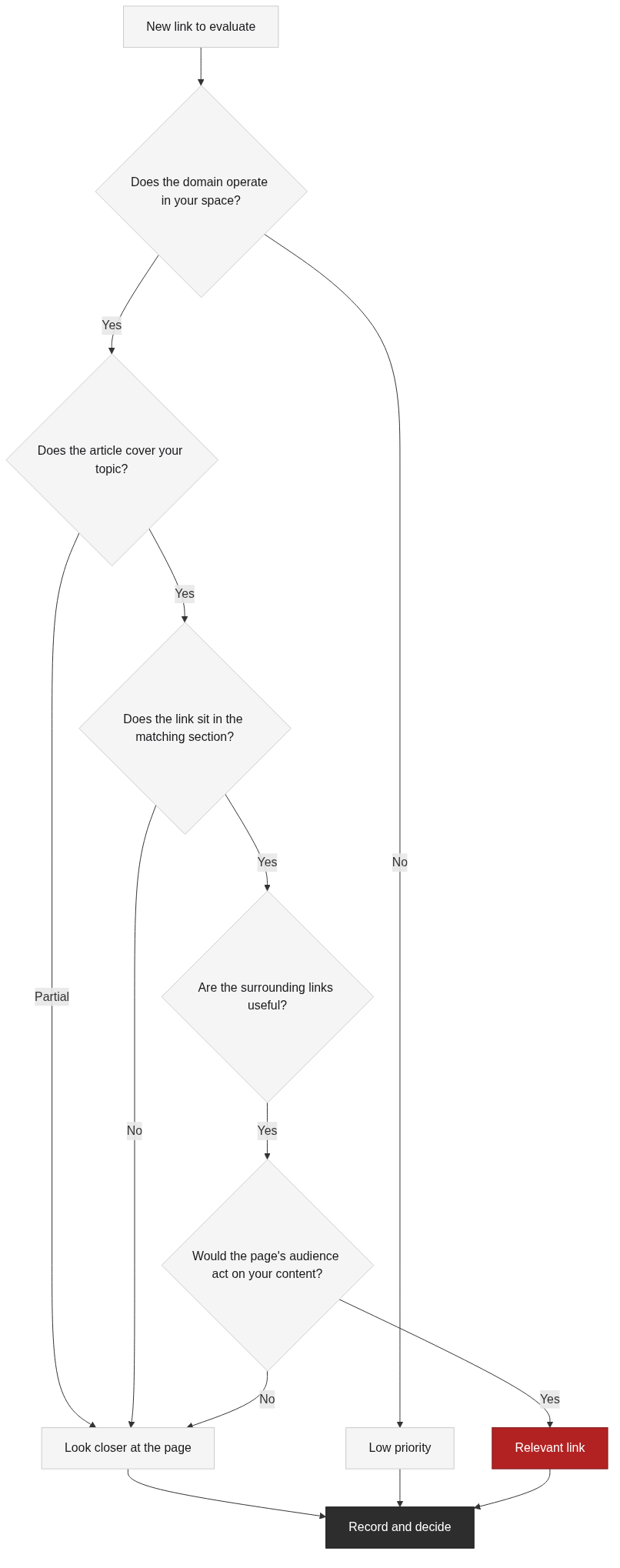
Page-level relevance is the link’s immediate context: the article it sits in, the section of the page that contains it, and the links that surround it. This layer decides whether the link reads naturally to a reader who found it on that page. A link buried in a roundup of unrelated resources has weaker page-level relevance than one placed in a paragraph that explains your exact topic.
Check three things about the page: whether the article topic matches yours, whether your link sits in the section that covers your subject, and whether the neighboring links point to pages a reader would actually want. When all three hold, the link earns its place; when only the domain is relevant, the link is weaker than it looks. The niche edits guide shows how teams find pages where the placement already fits.
Content and Audience Relevance: Who Actually Reads It
Content relevance is how well your page answers the question the referring page raises, and audience relevance is whether the people who read that page are the people you want to reach. The two go together: content that fits the context usually reaches the right readers, and the reverse is rare. A link from a page about SEO tools to your article about backlinks reaches readers who can act on the advice; a link from a page about gardening reaches almost no one in your audience.
Test audience relevance by asking what the reader does after clicking. A relevant reader lands on your page, finds the answer they were looking for, and keeps going; an irrelevant reader bounces because the page was never aimed at them. That behavior is why relevance influences both rankings and traffic quality, and why the link building strategies guide ranks relevance-focused methods above volume-focused ones.
Why Relevance Drives SEO Value (and Where It Does Not)
Relevance amplifies the value of every other quality factor. A relevant page is more likely to be maintained, more likely to place your link editorially, and more likely to attract the kind of visitors who engage with your content. Authority on an irrelevant page can still pass signals, but the context is missing, which makes the link harder to defend and less useful to readers.
Relevance does not replace authority or trust; it filters them. The strongest links combine all three, while a relevant link from a weak page is worth monitoring rather than celebrating. When relevance and authority conflict, the trade-off depends on the goal: for visibility in a niche, relevance usually matters more than raw domain strength [3].
How to Evaluate Relevance on Any Link
Start with the page, not the domain. Read the article, find your link in its context, and ask whether a reader of that article would click and stay. Then check the section, the surrounding links, and finally the domain’s overall topic. Write down what you find, because the notes become the reason you later keep or remove the link.
Use the three layers as a quick filter. A link that fails page-level relevance fails the filter even if the domain looks strong; a link that passes all three layers is a candidate for the rest of the framework, which the backlink profile guide covers from the whole-profile side.
How to Earn Relevant Backlinks
Relevant backlinks are usually earned by creating pages that fit existing contexts, then asking for the specific placement. Build content that matches a topic publishers already cover, list the places where your page would genuinely belong, and pitch the exact spot. The resource page link building guide walks through finding curated lists and earning a place on them.
Avoid the shortcut that relevance testing is meant to catch: bulk requests to any page with a high metric, the kind of pattern Google’s spam policies describe as link spam [4]. A hundred weak placements are harder to defend than a few relevant ones, and related coverage in this cluster goes deeper into referring domains and unnatural links, which are the two sides of the same question.

A Relevance Checklist for Link Evaluation
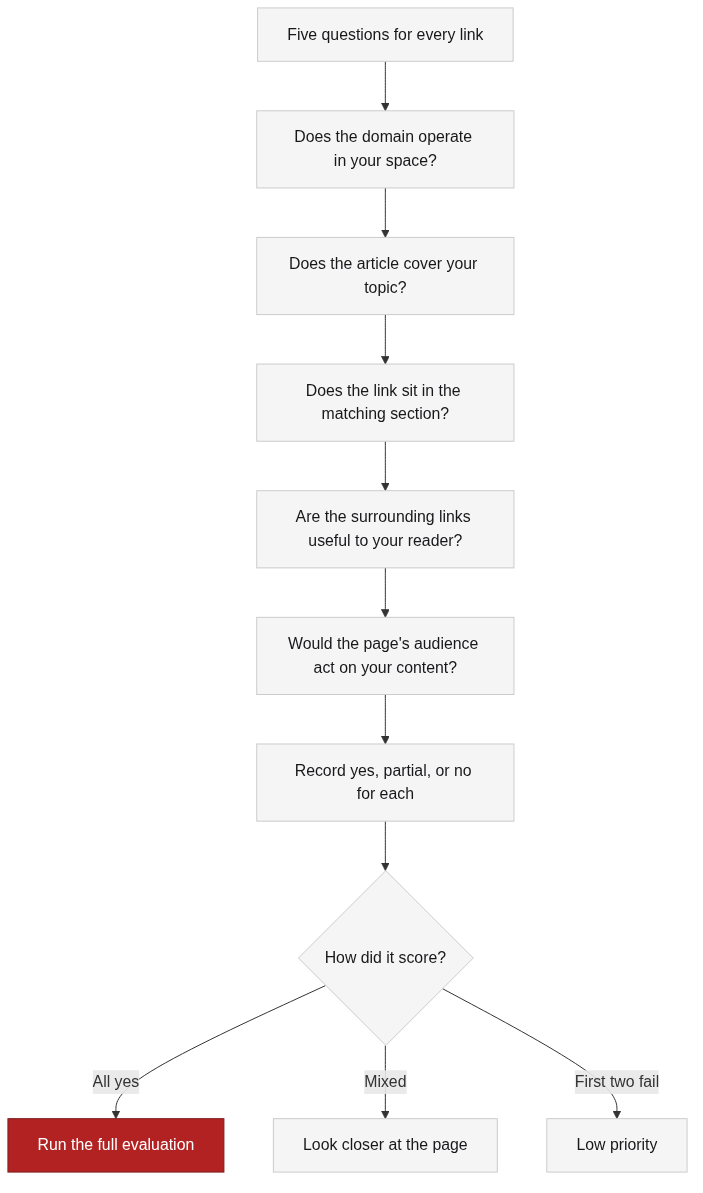
Turn the framework into a repeatable check with five questions. Does the domain operate in your space? Does the article cover your topic? Does your link sit in the matching section? Are the surrounding links useful to your reader? Would the page’s audience act on your content? Score each as yes, partial, or no, and record the reason.
Use the results to decide effort, not to issue a verdict. A link with all yes answers is worth pursuing through the full evaluation; a link with mixed answers is worth a closer look at the page before you decide; a link that fails the first two questions is low priority regardless of its metrics [5].
FAQ
References
Google, “SEO Starter Guide,” developers.google.com. Official documentation describing links among the signals that help pages gain visibility.
Moz, “Backlinks,” moz.com. Public glossary explaining what backlinks are and why relevance matters.
Ahrefs, “Link Building for SEO: The Definitive Guide,” ahrefs.com. Public industry guide describing how relevance and authority interact in link evaluation.
Google Search Central, “Spam policies for Google web search,” developers.google.com. Official documentation describing link spam practices that Google treats as policy violations.
Search Engine Journal, “Link Building Strategies,” searchenginejournal.com. Public industry article surveying link building methods and their trade-offs.
Next Steps
Relevance is the first filter in backlink evaluation: site-level topic, page-level context, and content and audience fit. Run the five-question checklist on the links you are evaluating, keep the notes, and treat mixed results as a reason to look closer rather than a verdict. Related coverage in this cluster goes deeper into high-quality backlinks, backlink profiles, referring domains, and unnatural links, and each article uses the same layered view of link quality.
If you prefer to focus on the strategy while a specialist handles execution, TraffiClimb builds premium link building programs for ambitious brands.