
What Is a Backlink Profile? How to Evaluate a Healthy Link Profile

What a Backlink Profile Actually Is
A backlink is a link from one page to another [2], and the backlink profile is every one of those links considered as a system. A single link tells you little on its own; the profile reveals the pattern, and search engines use links among the signals that decide which pages deserve visibility [1]. That is why audits start with the whole set rather than with one impressive domain.
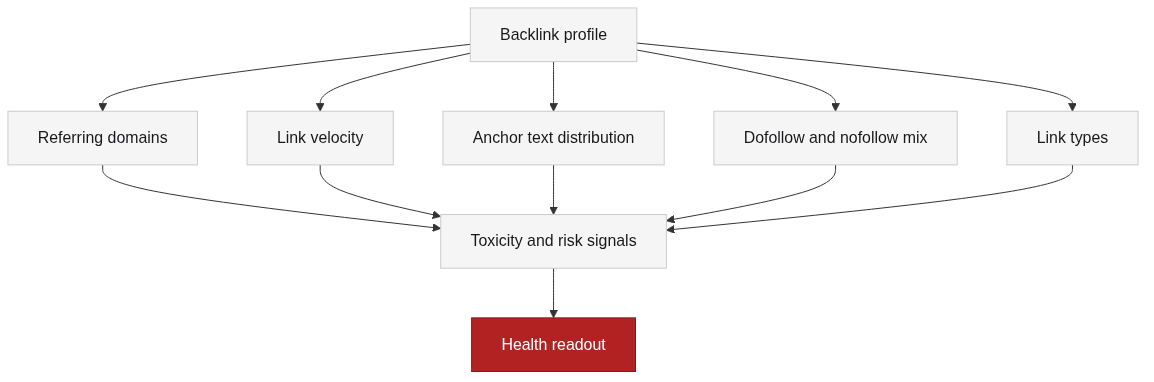
The profile has five observable parts: the referring domains, the speed at which links appeared, the distribution of anchor text, the mix of dofollow and nofollow links, and the types of pages providing the links. Each part can look reasonable in isolation and still hide a problem when the others contradict it, so the evaluation reads them together, the way standard link audits do [3].
Referring Domains: The Base of the Profile
Referring domains are the distinct sites that contain at least one link to you. They matter more than raw link counts, because a hundred links from one domain is a single relationship, while links from many unrelated domains show broader interest in your content. The count alone is still a blunt tool: two profiles with the same domain count can differ in quality if one earns links from relevant publishers and the other from link lists.
Judge referring domains by their diversity and their relevance, not just by their number. A healthy profile draws from a mix of sources that make sense for the niche, and no single domain dominates the whole set. When one domain accounts for a suspicious share of links, look at the pages behind it before you worry about the ratio.
Link Velocity: How Fast Your Profile Grows
Link velocity is the rate at which new links appear over time. Real profiles grow in fits and starts: a burst when a piece of content gets picked up, then a quiet stretch while the next asset is built. The problem is not speed but shape, because a steady stream of identical links arriving week after week looks manufactured.
Judge velocity against your own history and your publishing activity, not against an industry average. If a growth spike lines up with a launch or a campaign, it is easier to explain than a spike with no corresponding activity. When velocity is the reason an audit flags you, the underlying cause is usually a single source, and the link reclamation guide shows how to handle the links that stop being worth keeping.
Anchor Text Distribution: What Your Links Say
Anchor text is the clickable text of a link, and its distribution across the profile is one of the clearest health signals. Natural profiles carry a wide mix: brand names, plain URLs, descriptive phrases, and some exact-match anchors. The mix matters because it reflects how different writers described your page in their own words.
Exact-match anchors are not dangerous one by one. They become a signal worth investigating when they cluster, especially when the same anchor arrives in a short window from unrelated pages. A profile where one phrase dominates looks coordinated, whether or not it was, so the audit should always look at the distribution rather than the count of a single anchor.
Dofollow and Nofollow Mix: Not a Quality Metric
Dofollow links pass link equity signals, while nofollow links ask search engines to ignore the link for ranking purposes. Both belong in a healthy profile, and the mix depends on the platforms that naturally link to your kind of content. Comment sections, forums, and some social profiles use nofollow by default, so a high nofollow share is often a sign of earned mentions rather than a weakness.
Treat the mix as context for the rest of the profile, not a score. The useful question is whether the nofollow links come from real places that send traffic and build visibility, and whether the dofollow links sit on pages that are relevant and maintained. The pillar guide to high-quality backlinks covers how to judge those individual links in depth.
Link Types and Where They Come From
Links can be grouped by how they were earned: editorial mentions, content contributions, directories, profiles, and the occasional legacy link that appeared years ago. The mix tells you how much of the profile depends on active outreach versus organic attention. Profiles that rely on one method, such as a single directory or a single content format, are more exposed when that channel stops working.
Judge the mix by resilience, not by purity. A profile that blends editorial links with a few structured directories is easier to maintain than one built entirely on one tactic, and it survives algorithm changes better. The link building strategies guide ranks the methods by effort and risk so you can see where your own mix sits.

Toxicity and Risk Signals: What to Flag
Some links carry risk that outweighs their contribution. Flag links that were clearly paid for without disclosure, links from pages built mainly to pass link equity, and links that appear in bulk across a network of similar sites. The spam policies documentation from Google Search Central describes the practices Google treats as violations, and the practical rule is the same one used for single links: if the page exists to hold links rather than to serve readers, it does not belong in your profile [4].
Treat toxicity as a distribution, not a list. Nearly every profile has a few weak links, and a handful is usually not an emergency; the risk grows when the weak links share a pattern, such as the same anchor, the same timeframe, or the same source. Related coverage in this cluster goes deeper into unnatural links, and the broken link building guide offers a way to replace weak links with stronger ones instead of only removing them.
A Practical Backlink Profile Evaluation Checklist
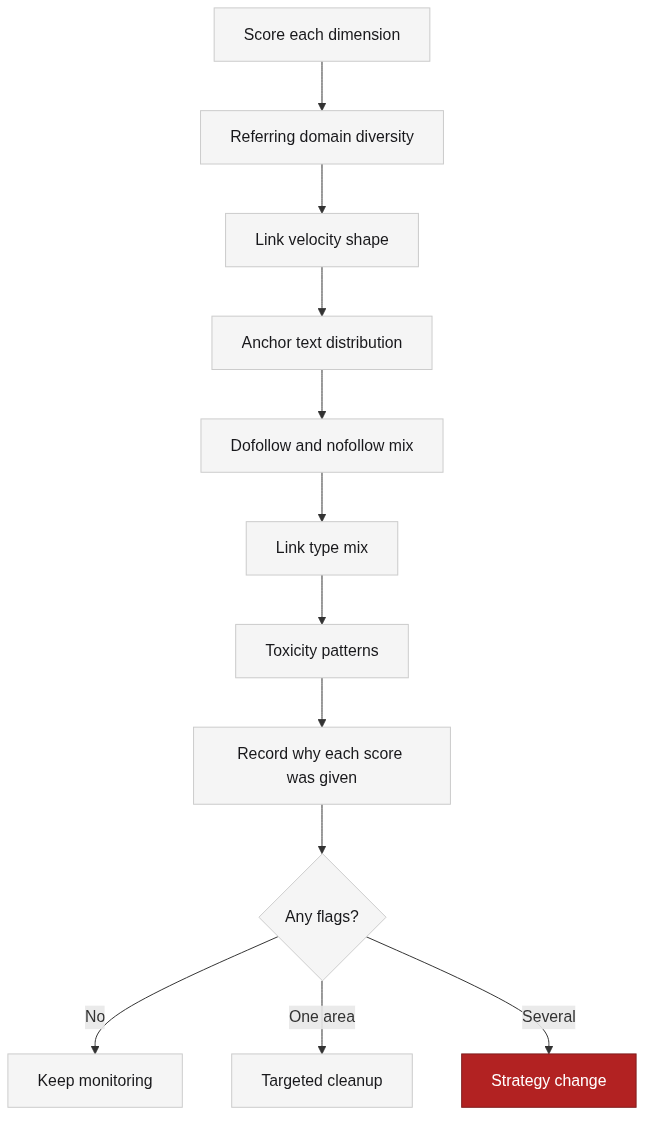
Turn the framework into a repeatable audit with a six-point checklist. Score each dimension as healthy, needs review, or flag: referring domain diversity, link velocity shape, anchor text distribution, dofollow and nofollow mix, link type mix, and toxicity patterns. Record why each dimension got its score, because the notes matter more than the labels.
Use the results to set priorities, not to issue a verdict. A profile with one flagged dimension and healthy everything else usually needs a targeted cleanup; a profile where several dimensions point the same way needs a strategy change, and that is where the link building strategies guide and the pillar guide help most [5].
FAQ
References
Google, “SEO Starter Guide,” developers.google.com. Official documentation describing links among the signals that help pages gain visibility.
Moz, “Backlinks,” moz.com. Public glossary explaining what backlinks are and why relevance matters.
Ahrefs, “Link Building for SEO: The Definitive Guide,” ahrefs.com. Public industry guide describing link audits and profile evaluation as part of link building.
Google Search Central, “Spam policies for Google web search,” developers.google.com. Official documentation describing link spam practices that Google treats as policy violations.
Search Engine Journal, “Link Building Strategies,” searchenginejournal.com. Public industry article surveying link building methods and their trade-offs.
Next Steps
A backlink profile is a system, and health comes from the pattern across referring domains, velocity, anchors, link types, and risk signals. Run the six-point checklist, keep the notes behind each score, and act on the pattern rather than on single links. Related coverage in this cluster goes deeper into high-quality backlinks, relevant backlinks, referring domains, and unnatural links, and each article reads the same system from a different angle.
If you prefer to focus on the strategy while a specialist handles execution, TraffiClimb builds premium link building programs for ambitious brands.