
High Quality Backlinks: How to Evaluate Backlink Quality in 2026

What Makes a Backlink High Quality
A backlink is a link from one page to another [2], and links remain one of the signals search engines use when deciding which pages deserve visibility [1]. A backlink becomes high quality when the referring page has meaningful authority, the page topic is relevant to your page, the placement is editorial rather than decorative, and the anchor text reads naturally. Each factor matters, but they interact: a strong page with no topical connection can be worth less than a modest page that sits inside the exact conversation your article belongs to.
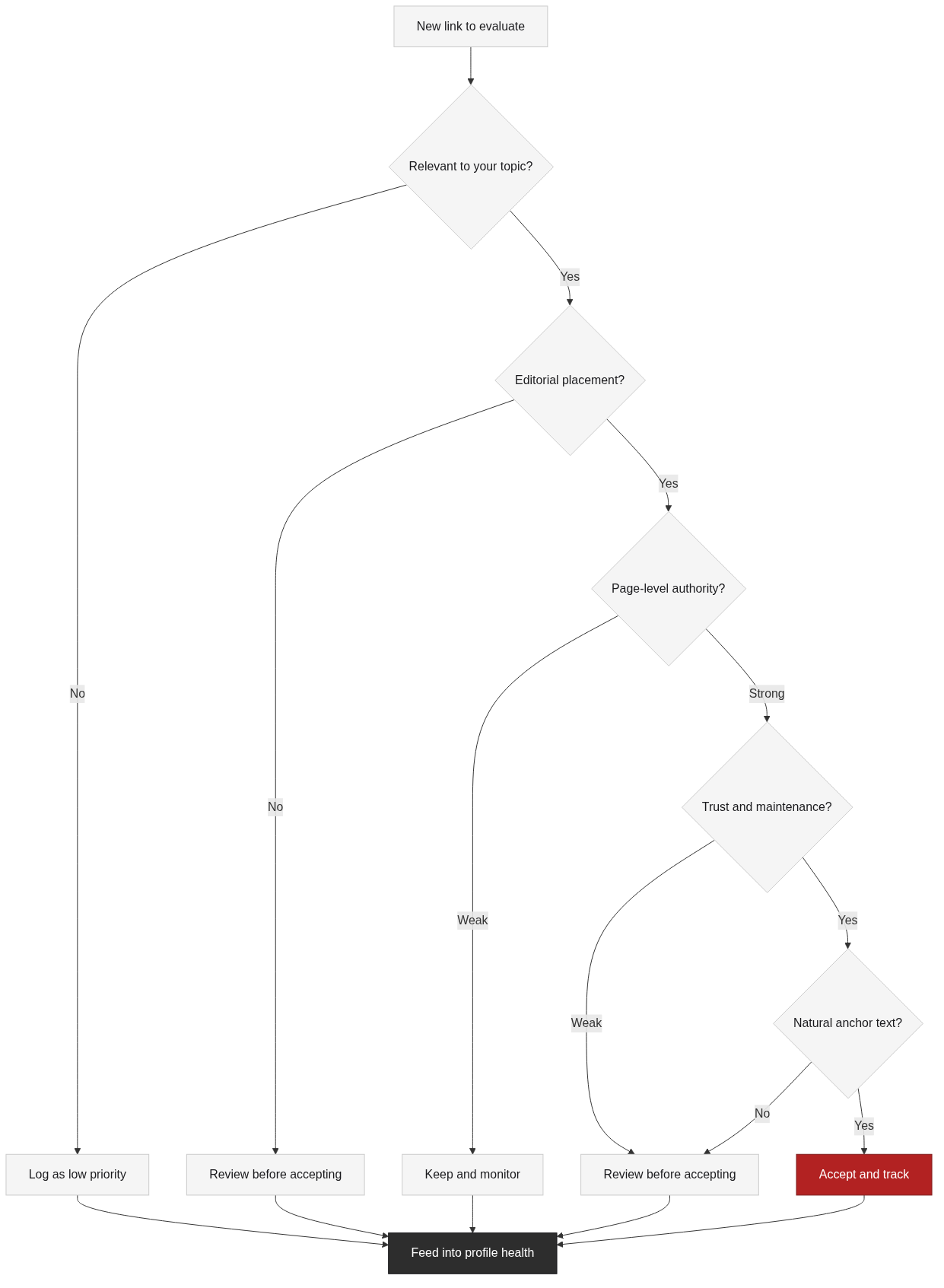
The order of checks matters as much as the factors themselves. Evaluate relevance and placement first, because they tell you whether the link makes sense to a reader; only then look at authority and trust signals. A link that fails the early checks usually fails the later ones too, so the sequence saves you from being impressed by a big domain name on an irrelevant page.
Authority: Judge the Page, Not Just the Domain
Authority is the referring page’s ability to pass influence to your page, and it is best judged at the page level rather than the domain level. Two pages on the same domain can differ wildly: a resource hub updated weekly, and an abandoned section that has not changed in years. Metrics that compress a whole domain into one number are a starting point, never a verdict.
Check what the page itself does before you trust its metrics. Is the page indexed? Does it rank for terms related to your topic? Does it attract comments, shares, or links of its own? When a page has no visible audience but the domain number looks strong, treat the link as low priority until you find the reason for the gap. The link building strategies guide explains how much weight to give authority versus effort when you plan a campaign.
Relevance: Topic Fit Matters More Than Raw Strength
Relevance is how closely the referring page’s topic matches your page’s topic. A link from a page about content marketing to an article about backlinks makes sense; a link from a general news page to the same article carries less context, even when the news domain is far stronger. Relevance is what makes a link useful to a reader and, by extension, what makes it defensible.
Relevance has three levels: the page topic, the section it sits in, and the surrounding links. The strongest links sit in a page section dedicated to your subject, surrounded by other pages a reader would actually want. When a page is nominally relevant but buries your link between unrelated links, the fit is weaker than it looks. If you want a framework for building the kind of pages that earn relevant links in the first place, the resource page link building guide covers that angle in detail.
Trust and Placement: Where the Link Sits Counts
Trust describes whether the referring site is an established, predictable publisher rather than a page built to pass links. Placement is where on the page your link appears. The two are usually evaluated together because a trusted site tends to place links editorially, while a link-focused page tends to bury them.
Editorial placement means your link is inside the main content, adds to the argument, and is one of a small number of outbound links on the page. Footer, sidebar, and template-wide links look like sitewide decoration and are weak regardless of the domain. A trusted page also gives you a stable home: the page stays live, the domain keeps publishing, and the context around your link does not change every month. When a page stops being maintained, the link degrades even though the URL still resolves.
Anchor Text: What the Link Says About Your Page
Anchor text is the clickable text of the link, and it shapes both how search engines interpret your page and how a reader decides whether to click. Natural anchors describe the page in plain language, match the sentence, and vary across your profile. Exact-match anchors that repeat your target phrase in identical form are a risk signal, especially when they arrive in clusters from unrelated pages.
Read the anchor in context before you evaluate it. A generic anchor like “click here” tells a search engine little, but it can still be valuable if the surrounding sentence is descriptive and the page is relevant. The opposite is also true: a perfect-looking anchor means little when it sits on a page nobody reads. Anchor text is one input into the overall judgment, not the judgment itself.
Link Profile Health: Evaluate the Set, Not the Single Link
A single link tells you little about a site. Link profile health is the pattern across the whole set: the mix of referring domains, the distribution of anchors, the share of relevant pages, and the speed at which links appeared. Link audits treat the whole profile as the unit of analysis, because patterns are what distinguish a site that earned attention from one that manufactured it [3].
Watch the relationships between links, not just the counts. A dozen links from the same domain is a different signal than a dozen links from a dozen domains. A cluster of identical anchors, a burst of links appearing in the same week, or a set of pages that all link to each other are the signs to investigate. Related reading in this cluster covers the backlink profile, relevant backlinks, referring domains, and unnatural links in more depth, and each of those topics feeds back into this framework.
Risk Signals: What to Flag Before Accepting a Link
Some links carry risk that outweighs any authority they might pass. Flag links that were clearly paid for without disclosure, links from pages built mainly to pass link equity, and links that appear in bulk across a network of similar sites. The spam policies documentation from Google Search Central describes the practices Google treats as violations, and the practical rule is simpler: if the page exists to hold links rather than to serve readers, do not put it in your profile [4].
Treat risk signals as context, not a binary pass or fail. A single commercial anchor in a footer is worth less than an editorial mention, but it is not an emergency on its own; the problem is when these signals accumulate across the profile. When you need to remove or disavow risky links, the link reclamation guide explains the recovery process, and the unlinked mentions guide covers the safer alternative of converting existing mentions into links.

A Scoring Checklist for Evaluating Backlinks
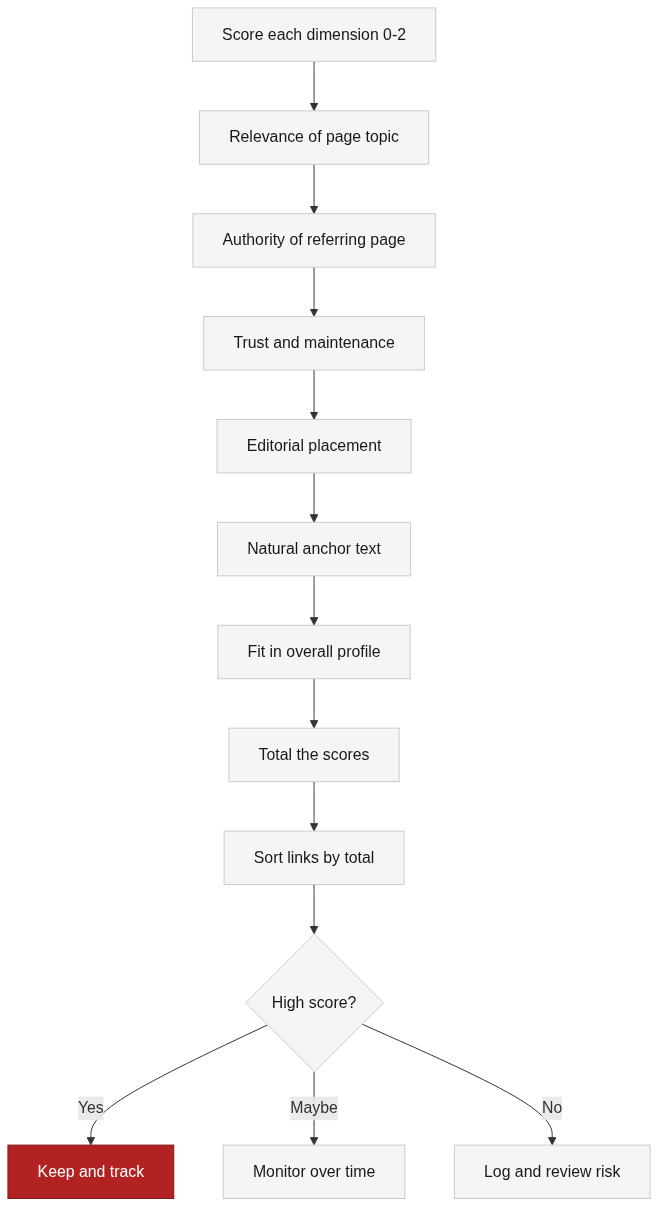
Turn the framework into a repeatable process with a simple scoring checklist, a pattern that fits how most guides frame the method and trade-off decisions [5]. For each link, score six dimensions from 0 to 2: relevance of the page topic, authority of the referring page, trust and maintenance of the site, editorial placement, natural anchor text, and fit within your overall profile. Total the scores and sort the results, rather than comparing links one by one.
Use the totals to decide the order of work, not to declare winners. A link scoring high on relevance and placement but low on authority is often worth keeping and worth monitoring; a link scoring low on relevance and high on risk signals should be logged and reviewed, regardless of the domain. The checklist works because it forces you to write down why each link scored the way it did, which is the part that most evaluations skip.
FAQ
References
Google, “SEO Starter Guide,” developers.google.com. Official documentation describing links among the signals that help pages gain visibility.
Moz, “Backlinks,” moz.com. Public glossary explaining what backlinks are and why relevance matters.
Ahrefs, “Link Building for SEO: The Definitive Guide,” ahrefs.com. Public industry guide describing link audits and evaluation as part of link building.
Google Search Central, “Spam policies for Google web search,” developers.google.com. Official documentation describing link spam practices that Google treats as policy violations.
Search Engine Journal, “Link Building Strategies,” searchenginejournal.com. Public industry article surveying link building methods and their trade-offs.
Next Steps
Evaluating backlink quality is a sequence of small judgments: relevance first, then authority, trust, placement, anchor text, and finally the fit inside your whole profile. The scoring checklist turns those judgments into a repeatable process, and the risk signals section tells you which links deserve a closer look before you accept them. Related coverage in this cluster goes deeper into the backlink profile, relevant backlinks, referring domains, and unnatural links, and each article returns to the same framework.
When you want to improve the profile rather than only judge it, start with the link building strategies guide and the broken link building guide, two methods that create new opportunities and fit the trade-offs most teams weigh [5]. If you prefer to focus on strategy while a specialist handles execution, TraffiClimb builds premium link building programs for ambitious brands.