
Guest Posting for Backlinks: A Step-by-Step Guide

What Guest Posting for Backlinks Actually Gets You
A guest post earns you a contextual backlink: the link appears inside an article the host published because that article is useful to their readers. Moz defines a backlink as a link from one page on another website, and the practical value depends on the relevance of that page and the audience that sees it [2]. Search engines still treat links as one of the signals that help a page become important, which is why Google’s SEO starter guide lists them among the factors worth investing in [1].
The upside of guest posting for backlinks is a link plus exposure. Readers who finish your post see your name and your site in a setting directly related to your topic, and some of them click through. The boundary is the host’s editorial bar: sites that accept anything for a fee, or that run low-quality guest post networks, produce links that search engines discount [3]. Reputable agencies refuse those placements, and so should you.
When Guest Posting Is the Right Method
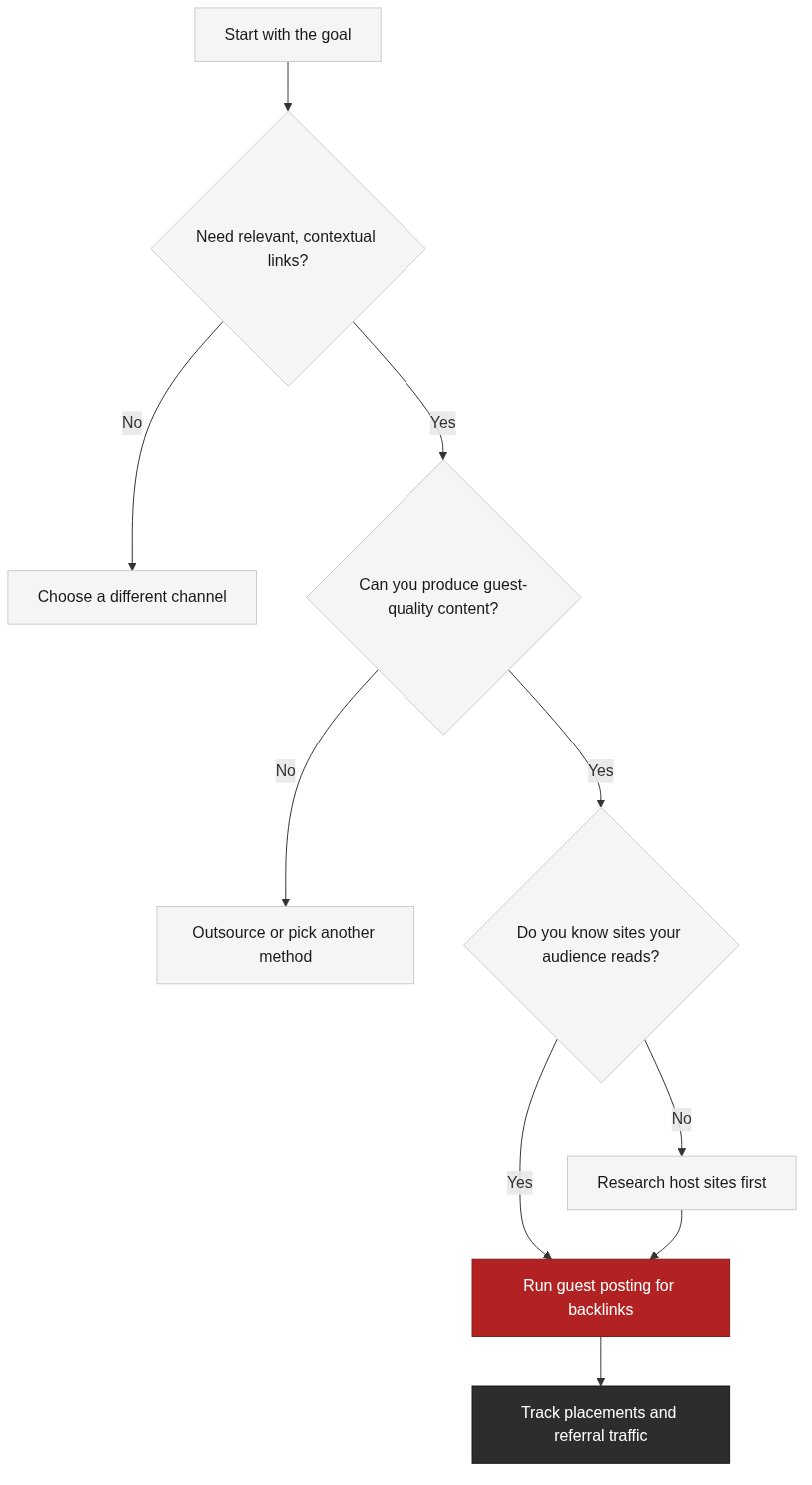
Guest posting for backlinks earns its keep when you can write credibly about a topic and you already know which sites your audience reads. It is a weak fit when you cannot meet a host’s editorial standards, or when the only goal is a large number of links in a short window. Backlinko’s guide to link building strategies still lists guest posting among the proven methods, but it is one tool in a mix, not the whole strategy [4].
Compare it with the alternatives before you commit. Resource page listings are cheaper when your page is reference material, but each placement is a single link. Unlinked brand mention outreach reuses content that already exists, but it only works if mentions exist. Digital PR can earn stronger links, but it needs a story or data and runs on a slower cycle [5]. Guest posting for backlinks sits in the middle: it needs writing capacity, it rewards patience, and it works best for topics where you can add something the host’s readers have not seen.
The full set of methods and the logic for combining them is covered in the pillar guide to link building strategies, which this article links back to as the entry point for the cluster.
Finding Host Sites Worth Pitching
Guest posting for backlinks depends on the quality of the target list, so start from the sites your audience already reads rather than a list of high-authority domains. A placement on a relevant site with a modest audience outperforms a link on an unrelated domain with a large one, because the context is what makes the link credible.
Build a list of 20 to 30 candidates using three filters. First, topical relevance: the site publishes about your industry or a directly adjacent one. Second, active publishing: recent posts, visible authors, and a functioning contact path. Third, editorial standards: the site has guidelines, discloses sponsored content, and does not run obvious paid link sections.
How to Vet a Host Before You Pitch
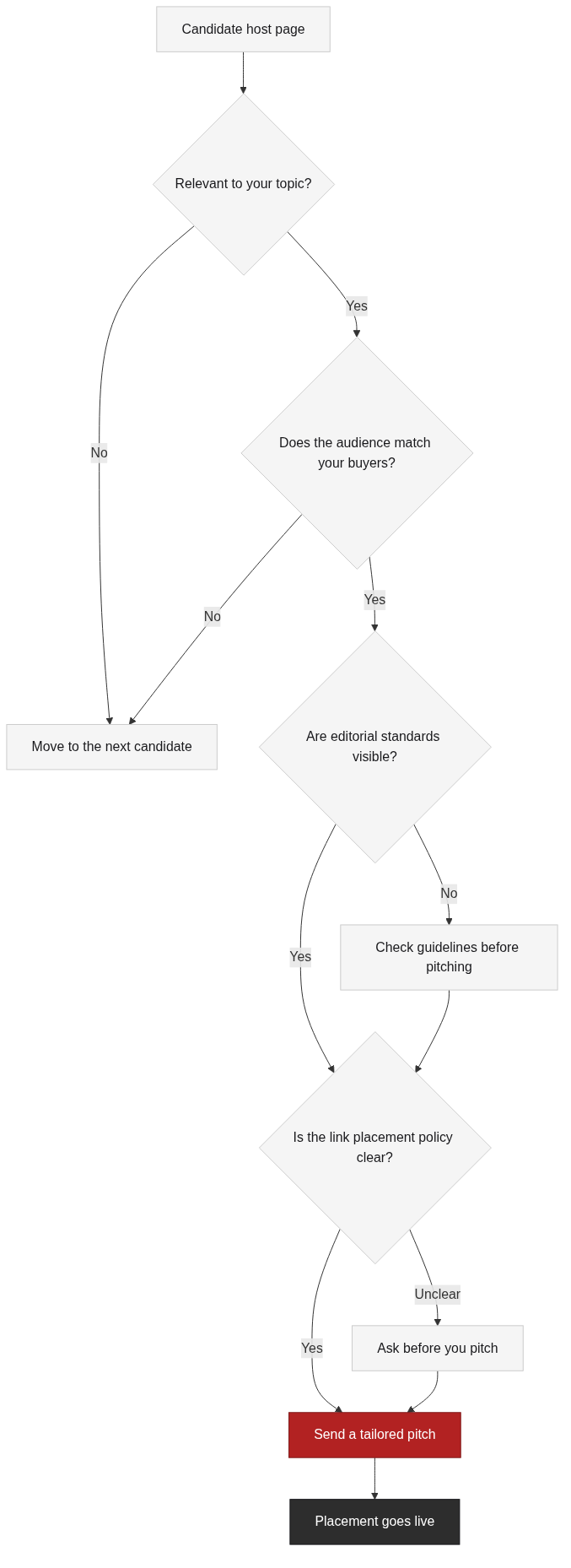
Relevance is the first filter, and it is also the one most people skip. Read the section of the site where your post would appear and ask whether a reader there would find your topic natural. Then check the audience fit: do the commenters, newsletters, and shared content look like people who could become your readers? A wrong host is the most common reason guest posting for backlinks earns nothing, so treat this step as a gate rather than a formality.
The second filter is placement policy. Some sites only allow links in the author bio, others allow in-content links when they add value, and a few require nofollow disclosure. The policy is not a dealbreaker, but it decides what you can pitch: an in-content link matters for rankings and referral traffic, while a bio link mostly builds visibility. Ask before you pitch when the rules are unclear, because a rejected draft wastes the writing work either way [3].
The Guest Posting Workflow, Step by Step
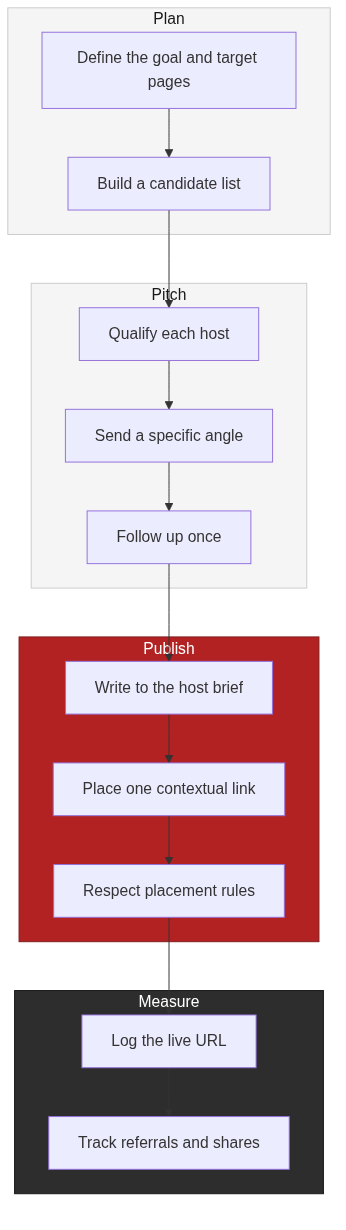
Guest posting for backlinks becomes reliable when the process is repeatable. Run it in seven steps, and keep each one small enough to repeat:
- Qualify each candidate with the relevance, audience, and editorial filters above.
- Read two recent posts from the section you want to write for.
- Find the angle that is useful to their readers and not already covered.
- Pitch that angle in three short paragraphs, with a working headline and a link to your best existing work.
- Write to their brief after the pitch is accepted, not before.
- Place a single contextual link to the page that serves the article’s point.
- Log the live URL, the placement date, and the anchor text.
Most teams overinvest in step five and underinvest in steps one and four, so their guest posting for backlinks never gains traction. The pitch decides whether the work happens at all, so spend the time there instead of polishing a draft for a site that was never a good fit [3].
Mistakes That Waste Most Pitches
Most failed guest posting for backlinks campaigns die in the pitch, not in the writing. Sending the same pitch to many sites is the fastest way to get ignored, because editors can tell when the angle was not written for them. Pitching a topic the host already covered better has the same result: your proposal needs a reason to exist on their site.
Two more mistakes are quieter. Treating the author bio as an in-content link makes the placement worth less than the work you put in, so clarify the policy before you commit. And chasing link count over fit produces placements that look good in a spreadsheet but send no relevant readers and no ranking context. Judge each opportunity by the audience and the placement, not by the domain’s authority alone.
How to Measure Results
The last stage of guest posting for backlinks is measurement, because a placement you cannot evaluate teaches you nothing. Track three things after a placement goes live: the link itself, the referral traffic it sends, and the context it creates. The link is verifiable by checking the live page and the anchor text. Referral traffic shows whether the host’s audience actually clicks, which is the earliest signal of fit. Context is harder to measure but matters most: a link from a page about your exact topic is worth more than one from a general directory, because it tells search engines what your page is about.
None of these numbers tell you much on their own. A placement with no clicks can still pass relevance signals, and one with heavy traffic can still be a poor fit if the audience never engages. Compare placements against each other over a few months, and use the pattern to decide which hosts deserve a second article [5].
FAQ
References
Google, “SEO Starter Guide,” developers.google.com. Official documentation describing links among the signals that help pages gain visibility.
Moz, “Backlinks,” moz.com. Public glossary explaining what backlinks are and why relevance matters.
Ahrefs, “Link Building for SEO: The Definitive Guide,” ahrefs.com. Public industry guide describing outreach and link-worthy content as the core of link building.
Backlinko, “Link Building Strategies,” backlinko.com. Public industry guide covering proven methods, including guest posting.
Search Engine Journal, “Link Building Strategies,” searchenginejournal.com. Public industry article surveying link building methods and their trade-offs.
Next Steps
Guest posting for backlinks is a repeatable process once the qualification loop is in place: build the list, vet each host, pitch a specific angle, and measure what each placement sends back. The pillar guide covers the full range of link building methods and how to combine them with this one.
If you would rather focus on the strategy while a specialist handles outreach, TraffiClimb builds premium link building programs for ambitious brands.