
AI Visibility Trackers: How to Monitor Brand Mentions and Citations in AI Search
 Written by Warren Reed

You run the same query in an AI assistant twice. The first time, your brand name appears in the answer. The second time, it is gone. One more run, and it is back with a different source cited. This is not a tool glitch — it is the core reality of measuring AI visibility, and it is exactly why an AI visibility tracker is both necessary and easy to misuse.
An AI visibility tracker can tell you how often your brand is mentioned and cited across a sampled set of prompts on platforms like ChatGPT, Google AI, and Perplexity. It cannot tell you your “ranking,” and it cannot be treated as a full count of real AI search traffic. This guide explains what these tools actually measure, where the data breaks down, and how to evaluate and use them without over-claiming.
What an AI Visibility Tracker Can and Cannot Prove
The most common mistake teams make is interpreting a single appearance as proof of “being included in AI search.” Because generative answers are nondeterministic, one appearance — or one absence — is a sample, not a verdict.
The Measurement Trap: One Appearance Is Not a Ranking
Imagine a stakeholder sees your brand cited in a ChatGPT answer and announces that “we’re showing up in AI search.” The same prompt run moments later produces a different answer with no mention of your brand. Neither observation is wrong; they are two draws from the same probabilistic system. Treating either as a stable result is the trap that an AI visibility tracker is designed to help you avoid — by aggregating many observations rather than relying on one.
The Core Question
So what can an AI visibility tracker actually prove? It can prove the rate at which your brand is mentioned and cited across a defined set of prompts on a defined set of platforms, over time. It cannot prove that your brand holds a fixed position, and it cannot prove a causal relationship between any single tactic and that rate. That distinction is the foundation for everything below.
Why AI Visibility Is Not Traditional Ranking
Traditional SEO measures a deterministic SERP position that you can verify by refreshing a page. AI visibility has no equivalent: the “answer” is generated fresh each time, so the unit of measurement is the frequency of mention and citation across many samples, not a rank. Once you accept that the deliverable is a trend and a relative signal — not a position — the tool becomes useful. Expecting a “rank” from an AI visibility tracker sets you up to misinterpret the data from day one.
What an AI Visibility Tracker Actually Measures: Mentions and Citations on a Sampled Query Set
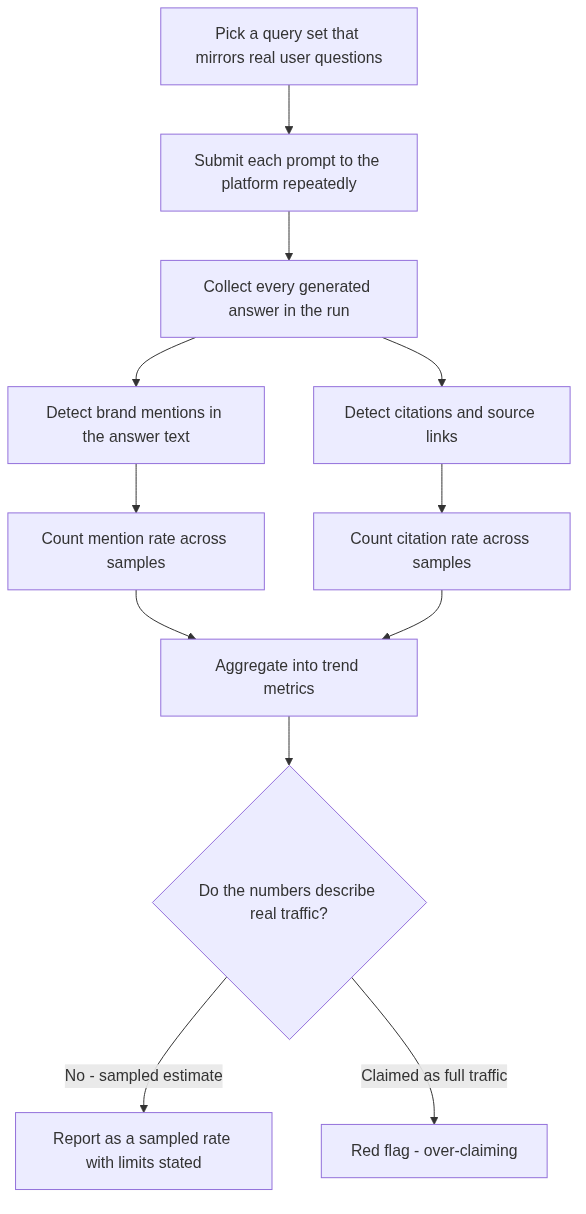
An AI visibility tracker works by taking a set of prompts and repeatedly submitting them to AI platforms, then counting how often your brand appears. That is the entire mechanism, and its limits define what the data means.
The Core Mechanism: Sampling a Query Set
Most trackers sample a set of queries — the query set — from a pool that is meant to represent how real users search. They then run these prompts through each platform repeatedly and aggregate the results. This is a sampling methodology, not a census: the tracker estimates mention and citation rates across the prompts it chose, under the model versions it queried. [1]
Mention vs. Citation: Two Signals, Two Meanings
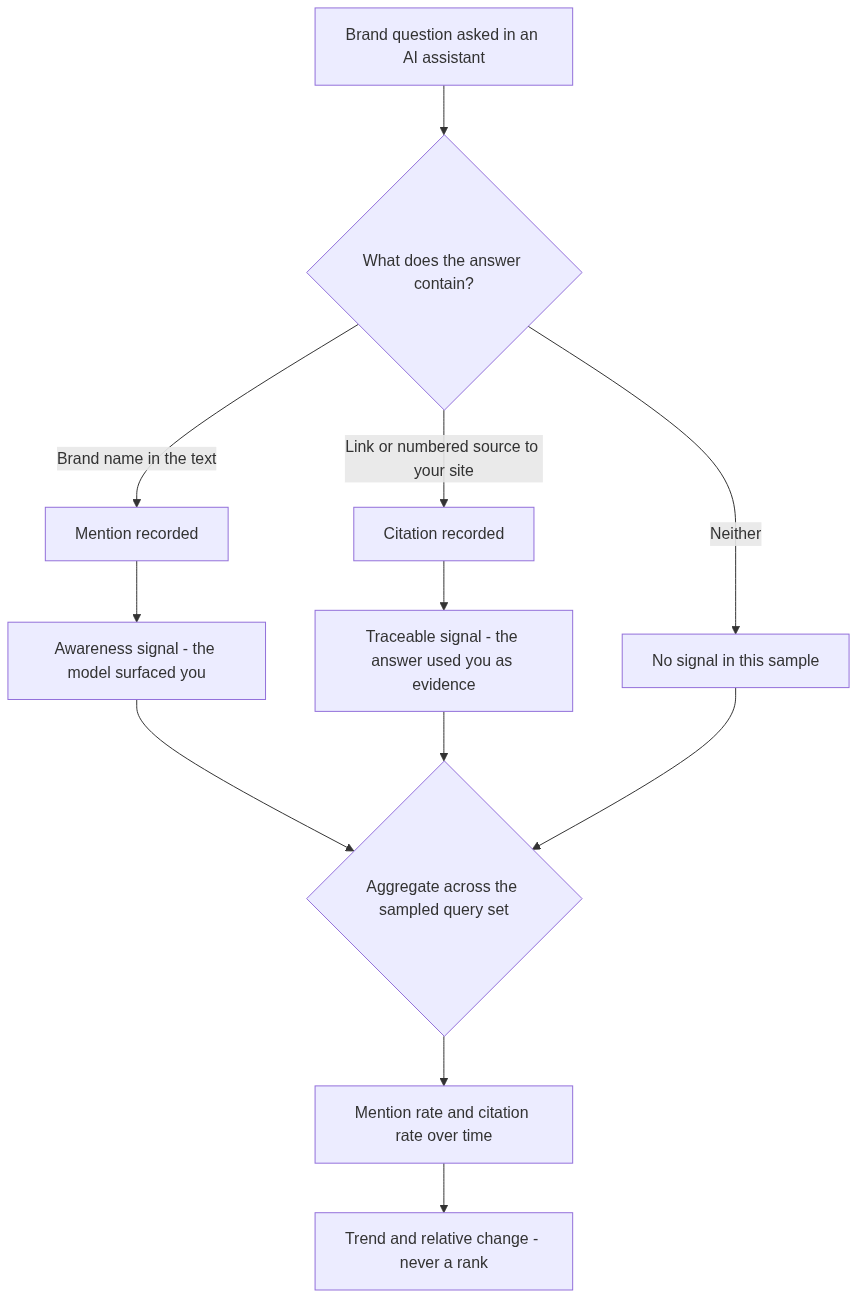
A mention means your brand name appears in the answer text. It is a brand-awareness signal — the model “knows” you and surfaces you in its response. A citation means the answer points to your site as a source, typically with a link or a numbered source. That is a traceable, citable signal. The two are not interchangeable: a brand can be mentioned without being cited, or cited without being named in prose. A mature tracking setup records both separately because they answer different questions — “are people being told about us?” versus “are we being referenced as evidence?” [2]
The Key Caveat: This Is Not Full AI Search Traffic
Because the tool measures a sampled query set, the output is a mention rate and a citation rate within that set — never a full count of real AI search traffic. The same caveat applies to share of voice: it is the share of mentions and citations within the sampled set, and it shifts when you change the query set, the platforms, or the model versions. [1] If a vendor presents its numbers as “your AI traffic,” that is a red flag, not a feature.
Platform Differences Shape Measurement: ChatGPT, Google AI, and Perplexity
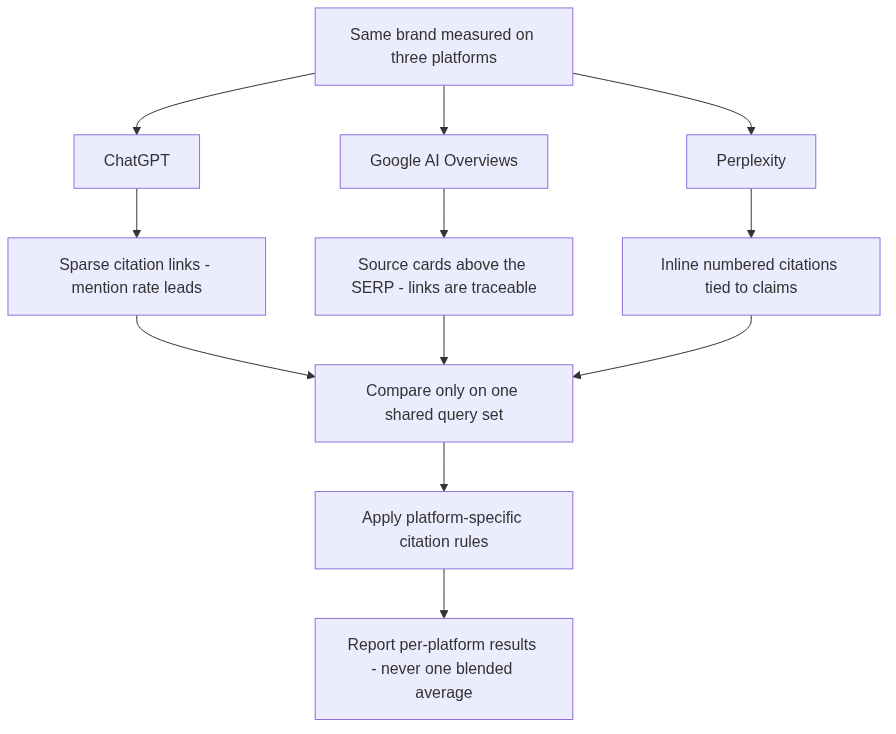
Platforms present citations differently, which means the same brand can look strong on one and weak on another for reasons that have nothing to do with your content. Cross-platform comparison only makes sense when you hold the query set constant and account for each platform’s citation behavior.
ChatGPT: Conversational, Sparse Citations
OpenAI’s ChatGPT search is conversational and citation-light relative to search-engine-style UIs. Answers frequently mention brands without attaching a visible source link, and the citation behavior can vary by model and interface. For tracking, this means the primary signal on ChatGPT is the mention rate; the citation signal is weaker and should be interpreted with that in mind. [3]
Google AI Overviews: Source Cards and Links
Google’s AI Overviews sit on top of the traditional SERP and typically include source cards with links, preserving a more traceable citation structure than a pure chat interface. This makes citation tracking more meaningful on Google AI — a cited link is a concrete, verifiable asset. The presence of the underlying SERP also means the measurement context is different from a chat box. [4]
Perplexity: Citation-Forward Design
Perplexity is designed around inline citations, with numbered sources attached to specific claims in the answer. This makes it the most citation-friendly of the three for tracking purposes: a citation is explicit, attributed to a claim, and relatively easy to classify. Teams focused on source citations often weight Perplexity data more heavily for exactly this reason. [5]
The Conclusion: Cross-Platform Comparison Requires a Controlled Setup
You can only compare platforms meaningfully if you (1) use the same query set across all of them and (2) apply platform-specific citation rules. A brand that is heavily cited on Perplexity but only mentioned on ChatGPT is not necessarily doing anything wrong — the platforms just measure different things. Any tracker or report that averages “visibility” across platforms without accounting for these differences is hiding more than it reveals.
Data Limitations and LLM Nondeterminism: Why Tracker Data Is Not Real Traffic
The single most important thing to understand about an AI visibility tracker is that its data is noisy by construction. That noise is not a bug you can fix by buying a better tool; it is inherent to the systems being measured.
Nondeterminism: The Same Prompt Gives Different Answers
Large language models use sampling during generation, so the same prompt submitted repeatedly can produce different answers, different wording, and different citations. [4] This means a single query is statistically unreliable on its own. Trackers compensate by running many samples and aggregating, but the underlying variance never disappears — it only gets averaged down. Any single number in a tracker report carries sampling error, and you should treat point values as estimates, not facts.
Sampling vs. Full Volume
The tracker measures a sample of prompts, not the full volume of AI search queries. Even a large, well-chosen query set is a proxy. It can tell you about the direction and magnitude of change within that set, but it cannot enumerate actual AI-driven sessions, clicks, or conversions. If your reporting needs those numbers, an AI visibility tracker is the wrong tool for that job. [1]
Historical Baseline Drift
Model updates, platform redesigns, and prompt-version changes all shift the baseline. A mention rate that rises after a model release may reflect the model’s new answer style more than any real change in your brand’s standing. When you compare data across time, you are not always comparing like with like — you are comparing across changing model behavior. [5] The practical consequence: watch relative changes and month-over-month trends, and be skeptical of any headline absolute number that jumps after a known platform update.
Tool Evaluation Overview: A Comparison Matrix of Evaluation Criteria
Because every tracker is a sampling instrument, the quality of its query set and the transparency of its methodology matter more than any single feature. Below is a framework of seven criteria to evaluate any AI visibility tracker.
The Seven Evaluation Criteria
| Evaluation Criterion | What to Look For | Why It Matters |
|---|---|---|
| Query set quality and scale | Does the tool let you define or import your own query set? Is it large enough (hundreds of prompts or more)? | The query set defines what is being measured; a narrow or generic set produces misleading rates. |
| Platform coverage | Does it cover the platforms you care about (ChatGPT, Google AI, Perplexity, Claude)? Can you split results by platform? | Citation behavior differs by platform, so coverage and segmentation determine whether cross-platform data is meaningful. |
| Mention vs. citation distinction | Does the tool separate brand mentions from source citations? Are citation rules visible? | The two signals answer different questions; conflating them hides insight. |
| Share of voice and competitor comparison | Does it compute SOV and compare competitors on the same query set? | SOV is only meaningful as a relative measure within a controlled set. |
| Historical trend retention | Does it keep history and let you observe change over time? Can it flag baseline drift? | Without history you cannot see trends; without drift detection you misread model-update noise as real change. |
| Reporting workflow | Can you export, schedule reports, and integrate with your BI/SEO stack? | The tool has to fit your reporting cadence or it will quietly fall out of use. |
| Data-limitation disclosure | Does the tool explicitly state that sampled data is not full AI search traffic? | A tool that hides its sampling limits invites the exact over-claiming this guide warns against. |
Business Scenario Comparison
The right tool depends on what you are trying to measure:
| Evaluation Dimension | Scenario A: Brand Awareness | Scenario B: Content & Source Strategy | Scenario C: Competitor Intelligence |
|---|---|---|---|
| Core focus | Mention rate | Citation rate + source quality | SOV + competitor comparison + reporting |
| Key query set | Brand terms + category terms | Long-tail informational prompts | Multi-client, multi-category sets |
| Platform coverage | All platforms | Google AI + Perplexity (citation-rich) | All platforms, scalable |
| Values history | Yes (growth measurement) | Yes (content cited over time) | Yes (cross-client baselines) |
| Data transparency need | High (sampling methodology) | High (citation rules) | Very high (deliverable to clients) |
| Recommended emphasis | Broad coverage + clear SOV | Citation-level granularity + traceable sources | Reporting workflow + strong competitor comparison |
From Matrix to Selection
Use the matrix as a filter, not a ranking. If your goal is brand awareness, prioritize platform coverage and SOV clarity. If your goal is content and source strategy, prioritize citation granularity and traceable sources. If you run an agency, prioritize reporting workflow and competitor comparison. The same tool can be a strong fit for one scenario and a poor fit for another — the matrix keeps you honest about which scenario you are actually in.
A Practical Decision Framework: The Tracker Selection Checklist
Before you commit to a tool, run it through an eight-point checklist. Each item guards against a specific way tracker data gets misused.
The Eight-Point Pre-Purchase Checklist
- Query set control — Can you define or import your own query set? Is it large enough (hundreds of prompts or more) to be statistically meaningful?
- Sampling transparency — Does the tool disclose its sampling method, sample count, and statistical approach? If it does not, the data is not trustworthy.
- Platform coverage — Does it cover the platforms you care about and let you split results by platform?
- Mention vs. citation — Does it distinguish brand mentions from source citations, and are the citation rules visible?
- SOV and competitor comparison — Does it support competitor comparison and share-of-voice on the same query set?
- Historical trends — Does it retain history, let you observe change, and help you identify model-update baseline drift?
- Reporting workflow — Can you export, schedule reports, and integrate with your existing BI or SEO tools?
- Data-limitation disclosure — Does the tool explicitly state that sampled data is not full AI search traffic? If it does not, treat any over-claiming as a red flag.
Red Lines for Interpreting Results
Three lines you should never cross when reading tracker output:
- Do not describe tracker data as real, full-volume AI search traffic. It is a sample.
- Do not promise a “ranking.” AI visibility has no stable rank; it has a mention/citation trend.
- Do not claim that backlinks are an AI ranking factor. Any observed association between links and AI visibility is a correlation, not a proven causal relationship, and should be reported as such.
Building a Sustainable Reporting Workflow
Set up reporting so it stays honest over time. Split results by platform, because each platform measures something different. Report relative change and trends rather than absolute values, because absolute numbers carry sampling noise and baseline drift. And when a known model update or platform redesign lands, flag the baseline shift explicitly instead of letting a headline number mislead your stakeholders. A sustainable workflow treats the tracker as a trend instrument, not a scoreboard.
Core Conclusions and Next Steps
An AI visibility tracker is a sampling instrument for mention and citation trends across a defined prompt set on defined platforms. Used correctly, it tells you whether your brand’s presence in generative answers is growing, shrinking, or stable relative to competitors. Used incorrectly, it produces confident-sounding numbers that mean very little.
The Bottom Line
The value of an AI visibility tracker lies in the trend and the relative change it reveals — not in any absolute value and not in a “ranking.” Every number it produces is an estimate shaped by the query set, the platform, the model version, and the sampling method. Read it as a directional signal, pair it with real analytics for actual traffic, and never let a single point value be the basis of a decision.
Your Next Step
Run the eight-point checklist against any tool you are considering, then pilot it on your own query set before committing. If you are still building out your measurement strategy, start with the fundamentals of how AI visibility and citations work before you buy anything.
Further Reading
To build on this foundation, explore how AI brand visibility is defined, how AI brand mentions are tracked, and how AI search citations behave across platforms.
If you are still shaping your measurement and link-building strategy for the AI search era, our link building guide walks through the compliance-first, content-driven approach that pairs with a solid measurement framework.
FAQ
References
OpenAI documentation on ChatGPT search and citations — Provides official guidance on how ChatGPT search surfaces sources and links, supporting the platform-specific measurement discussion.
Google documentation on AI Overviews and how they work — Official guidance on AI Overviews and source cards, supporting the Google AI measurement section.
Perplexity documentation on citations and sources — Official guidance on how Perplexity attaches inline citations to answers, supporting the citation-forward platform section.
OpenAI API documentation on sampling and temperature — Official guidance on model sampling and nondeterminism, supporting the LLM nondeterminism section.
Google Search Central documentation on AI Overviews — Official guidance on how AI Overviews relate to the traditional SERP, supporting the platform differences and baseline-drift discussion.