
Blogger Outreach for SEO: How to Build Relationships and Earn Relevant Links
 Written by Sanja Gajic

If you’ve ever sent a hundred outreach emails and watched almost all of them disappear into inboxes you’ll never hear from again, you already know the problem: blogger outreach is not a numbers game. The site owners who treat it as one usually end up with nothing except a reputation for spamming. The ones who earn durable, relevant links treat it as something else entirely — a relationship-building process where trust comes first and the link is the natural by-product.
This guide looks at blogger outreach from an SEO and link building perspective. We’ll define it, separate it from the broader link outreach you may already be running, walk through a relationship-first approach, map the four collaboration formats that actually earn relevant links, and end with a practical checklist you can use before you hit send. To be clear: this is not an influencer marketing tutorial. It’s a focused playbook for earning links that help you rank.
What Really Separates a Good Link from a Pile of Spam
The difference between a link that moves your rankings and a link that gets you flagged comes down to one thing: whether it was earned naturally or forced into place. Google’s guidance on link spam is explicit — large-scale article marketing, mass link exchanges, and paid links that aren’t disclosed are all treated as violations of its quality guidelines [1]. A link that a blogger added because it genuinely helps their readers is fundamentally different from a link you paid to place or begged for through a cold template.
The common mistake: treating blogger outreach as a bulk game
The most common failure mode is treating blogger outreach as “send a pile of emails + stuff in a link.” This produces two outcomes, and neither is good. Either your emails get ignored because they read like templates, or the ones that do get published trigger the link-scheme filters that can devalue your entire backlink profile. Neither outcome helps your SEO, and the second one actively hurts it.
The real view: blogger outreach is relationship building
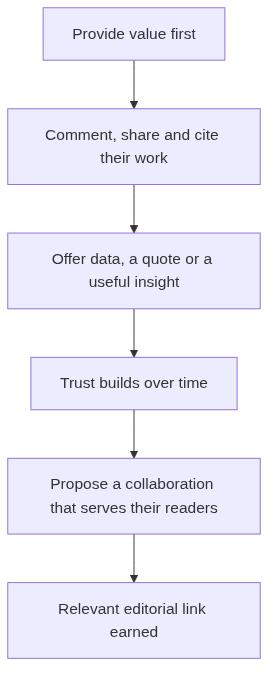
The opposite approach is what actually works. Blogger outreach is a form of relationship building — you establish trust over time, and relevant, sustainable links follow naturally. You comment, you share, you cite their work, you offer data or insight they can use. Only after you’ve provided value do you raise the possibility of a collaboration. This is slower, but it’s the difference between a one-off placement and a partnership you can draw on for years.
Establishing the SEO and link building lens
Throughout this guide, we weigh relevance over authority. A single link from a highly relevant blog with modest authority is usually worth more than a link from a high-DR page that has nothing to do with your topic. Public link research consistently supports this: relevance and content quality matter more than raw domain metrics [2]. We’ll also be honest about timing — link building, including blogger outreach, typically takes three to six months to show measurable impact on rankings [2]. Set expectations accordingly.
What Blogger Outreach Is — and How It Differs from Link Outreach
At its core, blogger outreach is the practice of building relationships with bloggers and content creators in your niche, with the goal of earning relevant backlinks, brand exposure, and referral traffic. The mechanism is relationship; the outcome is links and visibility.
A working definition
Blogger outreach means identifying the bloggers and content creators whose audiences overlap with your own, establishing a genuine relationship with them, and then proposing collaborations that add value to their readers. The link you earn is a by-product of that relationship, not the opening move. This is what separates it from a transactional pitch.
Blogger outreach vs link outreach
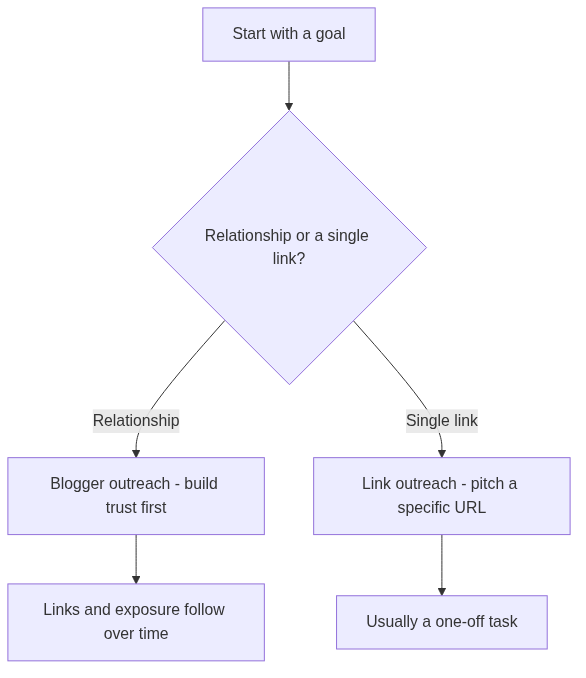
Link outreach is a broader and more transactional practice: you identify pages that could link to a specific URL and pitch them directly, usually as a one-off task. Blogger outreach is narrower and more relational. The table below lays out how the two differ across the dimensions that matter for planning.
| Dimension | Blogger Outreach | Link Outreach |
|---|---|---|
| Core goal | Long-term relationships + brand exposure + relevant links | Earn a single or bulk link for a specific URL |
| Time scale | Long-term (weeks to months), relationship compounds | Short-term, usually a one-off task |
| Target | Relevant bloggers / content creators | Any site owner / editor with link value |
| Value proposition | Content value exchange, win-win collaboration | Clear link request + equivalent value offered |
| Success metrics | Relationship quality, natural links, brand mentions, traffic | Link count, DR/DA, anchor text |
| Risk | Mass templating can trigger spam-link detection | Mass outreach can trigger link-scheme detection |
| Best fit | Brand building, long-term SEO, content distribution | Specific page rankings, resource links, competitor backlinks |
When blogger outreach fits — and where its boundary is
Blogger outreach fits best in the education-to-implementation stage: you understand the strategy and you’re ready to start executing. It’s ideal when you want ongoing brand visibility and a stream of natural links rather than a one-off placement. Its boundary is equally clear — it is not a full influencer-marketing program. We’re not covering paid influencer campaigns, affiliate seeding at scale, or social amplification. We’re focused on the SEO-relevant core: relationships that earn links.
Relationship-First: Why Links Come After Trust
The single most important shift you can make is to stop asking for links and start building trust. Cold, templated outreach that opens with a link request is the fastest way to get ignored — and, at scale, the fastest way to trip Google’s link-spam filters [1].
The anti-pattern: cold templates that ask for a link immediately
A generic email that says “I love your blog, check out my post and please link to it” doesn’t build trust; it signals you didn’t do any homework. When enough of these go out, they read as link schemes, which is exactly the behavior Google’s quality guidelines are designed to catch [1]. Personalized outreach consistently outperforms mass templates — messages that reference a blogger’s specific content, data, or viewpoint are far more likely to get a reply than a fill-in-the-blank template [3].
The right path: provide value first
Before you ever ask for anything, give. Comment thoughtfully on their posts. Share their work with your audience. Cite their content in your own writing. Offer them original data, an expert quote, or an insight they can use. This is the value-proposition core of blogger outreach: every collaboration should be a win for the blogger’s readers too, not a one-sided extraction.
How to find relevant bloggers
When you’re building your target list, filter for topical relevance before you look at authority. A blogger who covers your exact niche, writes consistently, and has an engaged audience is worth more to you than a high-authority site that only occasionally touches your topic. This aligns with the consensus that relevance and content quality outweigh raw domain metrics [2]. For the full prospecting methodology, our guide on link prospecting covers how to build and vet this list at scale.
Personalization and follow-up principles
Two habits separate effective outreach from noise. First, personalize: reference something specific about the blogger’s recent post, a data point they shared, or a viewpoint you genuinely engaged with. Second, follow up: a single send without a follow-up leaves a large share of potentially convertible replies on the table. Use a reasonable interval and keep the follow-up short — you’re nudging, not nagging [3]. For concrete wording, see our outreach email templates.
Four Collaboration Formats That Earn Relevant Links
Once you’ve built the relationship, the collaboration itself can take several forms. Each has different effort, payoff, and risk. Here are the four that earn relevant links most consistently.
Guest contribution
Guest posts remain a reliable way to earn a relevant link and professional exposure — provided they respect Google’s boundaries around guest-post abuse. The rule is simple: quality and relevance come first. A well-researched, genuinely useful guest post on a relevant blog is a legitimate content contribution; a mass-produced article stuffed with links is a link scheme [1]. If you’re planning to scale guest posting, our guest posting guide walks through the compliance-safe approach.
Product and expert contribution
If you have a product or tool bloggers can actually use, offer them a genuine hands-on experience in exchange for an honest review or natural mention. The review must reflect a real experience — fabricated reviews help no one. Alternatively, offer your expertise: a sharp insight, a data point, or a quotable perspective that the blogger can cite in their content. Expert contributions are low effort, and being cited as a source builds authority and earns a natural link back to you.
Content promotion
If you already have a genuinely linkable piece of content — original research, a definitive guide, a useful tool — promote it directly to relevant bloggers. You’re not asking them to link; you’re telling them about a resource their readers would find valuable. If the content is good enough, the link comes naturally. This is the most scalable format, but it only works if the asset is genuinely excellent; mediocre content gets no links [3].
Choosing the right format
The table below compares the four formats across effort, output, best-fit scenario, and primary risk.
| Format | Effort | Output | Best fit | Primary risk |
|---|---|---|---|---|
| Guest Contribution | High (writing + editing) | Relevant link + professional exposure | Target blog accepts guests and topic aligns | Guest-post abuse triggers guidelines |
| Product | Medium (provide access) | Review / natural mention | You have an experienceable product or tool | Must ensure a genuine experience |
| Expert Contribution | Low (provide a viewpoint) | Cited as source + authority | You have exportable insight or data | Must offer a real, value-adding viewpoint |
| Content Promotion | Medium (content + outreach) | Natural link + shares | You already have a strong linkable asset | Poor content produces no result |
Compliance, Disclosure, and How to Measure Success
Sustainable growth through blogger outreach rests on two pillars: compliance and honest measurement. Skip either and you’re building on sand.
Sponsored collaboration disclosure
If a collaboration is paid or sponsored — including free product in exchange for a review or a paid placement — it must be clearly disclosed. Undisclosed paid links violate search engine guidelines and, in many regions, advertising law [1][4]. In the United States, the FTC’s endorsement guides require that material connections between an advertiser and an endorser be clearly and conspicuously disclosed [4]. Disclosure isn’t just a legal safeguard; it’s also what keeps your links from looking like paid schemes to search engines. If you’re weighing whether to run this yourself or outsource it, our link building outreach pillar covers the full compliance-first workflow.
How to evaluate results
Too many teams measure success by DR/DA and raw link count. Those matter, but they’re secondary. The metrics that actually indicate a healthy blogger outreach program are:
- Relevance — do the links and mentions come from your actual niche?
- Natural link quality — were the links added editorially because they help readers, not paid or squeezed in?
- Referral traffic — is the blog actually sending you visitors?
- Brand exposure — non-link mentions and brand awareness count for something.
- Relationship asset — can you draw on this blogger again for future collaborations?
DR/DA and link count are reference points, not the whole story. The table below shows how to weight them.
| Metric | What it tells you | Weight |
|---|---|---|
| Relevance | Links come from your actual niche | ★★★ Core |
| Natural link quality | Links added editorially, not paid | ★★★ Core |
| Referral traffic | The blog sends you visitors | ★★ |
| Brand exposure / mentions | Non-link mentions still build awareness | ★★ |
| Relationship asset | Reusable long-term partnership | ★★ Long-term payoff |
| DR/DA and quantity | Reference point, not the sole standard | ★ Secondary |
The sustainable growth stance
Compliance, transparency, and traceability are the prerequisites for long-term link building. This isn’t a compliance box to tick; it’s the foundation that keeps your backlink profile from becoming a liability. A strategy built on disclosed, editorially-earned links compounds; one built on shortcuts collapses the first time the algorithm catches up.
Blogger Outreach in Practice: Checklists and Decision Frameworks
Theory is only useful if it changes what you do next. Here’s how to put blogger outreach into practice.
Pre-send checklist
Run through this before every outreach email. If you can’t check every box, the message isn’t ready.
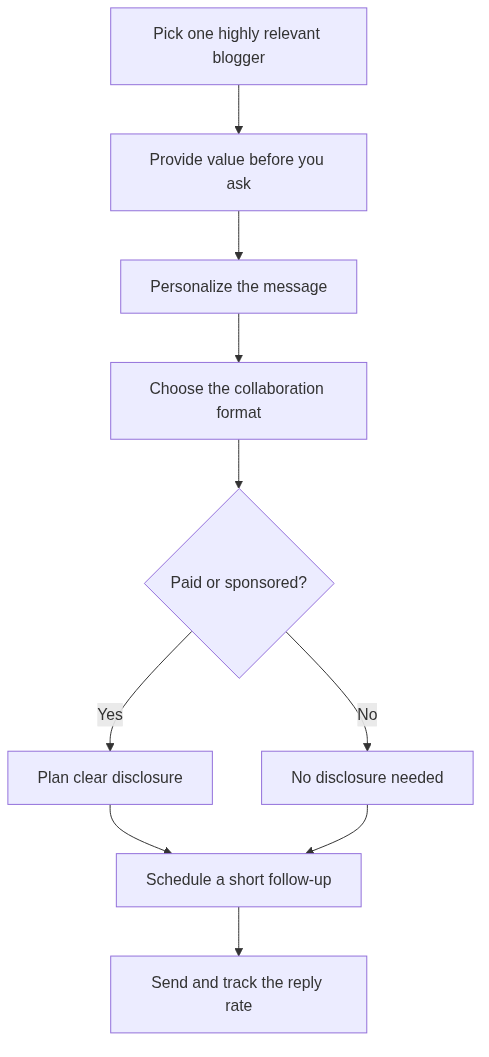
- Is this blogger highly relevant to my topic? (Relevance over authority.)
- Have I already provided value — commented, shared, or cited their content — rather than asking first?
- Is my email personalized, referencing their specific content or viewpoint rather than a template?
- Is my value proposition genuinely useful to their readers (a win-win)?
- Have I chosen the right collaboration format (guest / product / expert / content promotion)?
- If paid or sponsored, have I planned for clear disclosure?
- Have I planned a reasonable follow-up (interval + short resend) rather than a single send?
When to consider outsourcing
Blogger outreach done right is slow, tactful, and labor-intensive. If your in-house team lacks the bandwidth or the experience to maintain dozens of relationships and follow-ups over months, it’s worth considering a specialist. A professional link building service handles the relationship-heavy, compliance-first work so your team can focus on the content and strategy side. If you’re at that point, look into our outsourced link building service — or start with the link building outreach pillar to understand what a compliant program involves.
Core Takeaways and Your Next Step
The pattern runs through everything we’ve covered: relationship first, links second; relevance over authority; personalization and follow-up as non-negotiables; and disclosure as a non-negotiable part of any paid or sponsored collaboration.
The core conclusions
Blogger outreach is a relationship-building practice, not a bulk-email game. Links come after trust is established. Relevance matters more than authority. Personalization and follow-up are standard practice, not optional extras. And compliance disclosure is not negotiable — it protects both your rankings and your legal standing.
Your next action
Don’t try to do this at scale on day one. Pick a single highly relevant, topically aligned blogger. Run them through the pre-send checklist: provide value first, personalize your message, choose the right format, plan your disclosure if needed, and schedule your follow-up. Get one relationship right, learn from it, and scale from there.
When to bring in a partner
If the relationship-heavy work of blogger outreach stretches your team’s capacity — or if you want a compliance-first approach without building the in-house operation from scratch — that’s exactly what a link building partner is for. Explore our link building outreach guide, then consider outsourcing your link building to a team that treats relationships and compliance as the foundation of sustainable growth.
FAQ
Conclusion
Blogger outreach for SEO is not about volume — it’s about relationships. Earn trust first, prioritize relevance over authority, personalize every message, follow up thoughtfully, and never skip disclosure on a paid or sponsored collaboration. Done right, it produces the most durable asset in link building: a network of relevant creators who link to you because your content genuinely serves their readers. Budget for a longer horizon than you would for paid tactics: a first reply often takes two or three touches, and a link may only arrive months after the introduction. Track reply rates and relationship quality rather than raw outreach volume, and revisit prospects who said no once you have something new worth sharing. Start small, get one relationship right, and scale from there — or hand the relationship-heavy work to a compliance-first link building partner if your team can’t sustain it.
References
Google Search Central, “Spam policies” — Google’s official quality guidelines that classify large-scale article marketing, mass link exchanges, and undisclosed paid links as link spam violations.
Ahrefs Blog — Public link research and industry consensus supporting the view that relevance and content quality outweigh raw domain authority, and that link building takes 3–6 months to show impact.
Backlinko — Public SEO research and industry consensus on outreach, personalization response rates, follow-up as a necessary step, and content promotion effectiveness.
Federal Trade Commission, “FTC’s Endorsement Guides: What People Are Asking” — US advertising guidance requiring clear and conspicuous disclosure of material connections between advertisers and endorsers.