
Automated Link Building: What You Can Automate, Tools, and Risks
 Written by Alistair MacLeod
Most SEO teams hear “automated link building” and picture a tool that fires off hundreds of backlinks in bulk. That mental model is wrong, and it usually leads to one of two outcomes: either you avoid automation entirely out of fear, or you chase a shortcut that ends in a penalty. The useful version of automated link building is neither. It means taking the repetitive, rule-driven steps of your link building workflow and handing them to software, while keeping the decisions that require judgment in human hands. Done right, it can compress the most time-consuming parts of your process by an order of magnitude without ever touching the “place the link” step itself.
This guide breaks the full workflow into three clear buckets: what you can safely automate, what needs human judgment, and what should never be automated. You’ll get a practical decision framework, a rollout order, and a clear picture of the risks that justify keeping some steps manual.
Rethinking “Automated Link Building”: You Automate the Workflow, Not the Links
The phrase “automated link building” is overloaded, and that ambiguity is exactly why it scares people. Let’s separate the fear from the reality before we touch a single tool.
The common misconception: “one-click auto backlinks” triggers the penalty reflex
When you search the term, you’ll find tools that promise to generate links at scale with minimal input. That framing is the source of the concern, and for good reason: search engines maintain explicit policies against link schemes, and bulk-generated or purchased links are the classic example of behavior that gets a site flagged. So the reflex to be cautious is healthy. The mistake is assuming that every form of automation is a link scheme. It isn’t. Automation is a way of doing mechanical work faster; whether it’s legitimate depends entirely on which steps you automate and how.
The core promise of this guide: dissect the workflow, not the tool
The useful way to think about automated link building is as a workflow problem, not a backlink generator. A link building process has distinct stages, and each stage has a different tolerance for automation. Some stages are pure data handling and are ideal candidates. Others involve subjective judgment about relevance, fit, and relationships, and they degrade badly when you try to automate them. This guide maps each stage, tells you which class it falls into, and gives you the reasoning so you can apply it to your own process even as tools change.
The human-in-the-loop payoff: 10x speed on the repetitive steps
The real win from automation isn’t volume for its own sake. It’s that you spend your limited human attention on the decisions that actually move results, instead of on scraping, sorting, and scheduling. When you automate prospecting, contact discovery, email verification, follow-up cadence, and monitoring, the repetitive overhead largely disappears. What’s left for a human is a smaller, higher-value set of tasks: reviewing relevance, tailoring the message, and auditing risk. That division is the entire thesis of this article.
What Automated Link Building Really Is: A Workflow, Not a Backlink Generator
Let’s define the term precisely, because the rest of the article depends on it. Automated link building is the practice of using software to execute the rule-driven, repeatable stages of a link building workflow, while reserving the stages that require subjective judgment for people.
Map the full link building workflow
A complete link building operation runs through six stages:
- Prospecting — discovering candidate sites and scoring them by authority, relevance, and traffic.
- Contact discovery — finding the right person’s email address on each candidate site.
- Email verification — confirming those addresses are valid before you send.
- Outreach — writing and sending the pitch itself.
- Follow-up — the cadence-driven sequence of reminders that turns a first touch into a conversation.
- Monitoring and reporting — tracking which links you gained, which you lost, and what changed.
Every one of these stages sits somewhere on a spectrum from “perfect for automation” to “should stay fully manual.” The next section draws that line.
The three-way classification: automatable, needs human judgment, never automate
The whole article hangs on this split:
| Workflow stage | Classification | Why |
|---|---|---|
| Prospecting (discovery + scoring) | Automatable | Rule-driven: filter by authority, relevance, traffic metrics |
| Contact discovery | Automatable | Mechanical extraction of contact details |
| Email verification | Automatable | Verifiable, data-driven, reduces bounce rate |
| Outreach copy drafting | Human judgment | Needs tailoring, tone, and personalization |
| Follow-up sequences | Automatable | Cadence is rule-driven; the message still needs a human touch |
| Monitoring and reporting | Automatable | Scheduled checks and alerts are mechanical |
| Placing / purchasing links | Never automate | Touches quality guidelines directly |
This classification is the lens through which every decision in this guide should be read.

Market evidence of the split: scale platforms vs. judgment-driven services
The market already reflects this divide. Large automation-driven marketplaces scale volume through tooling and integration: MeUp reports 150,000+ reviewed sites and 80,000+ unique domains [1], and WhitePress has operated across 26+ language markets since 2013 [2]. On the other side, people-driven services emphasize judgment and speed of delivery: BaZoom reports 80,000+ media channels with an average four-day publish turnaround [3]. Neither model is “wrong” — they fit different needs. The point is that even the biggest automation platforms still sit on top of human review and editorial judgment, which is exactly the boundary this guide is drawing. For a fuller look at how prospecting feeds into outreach, see our guide to link prospecting and the link prospecting tools that power it, then connect the dots to link building outreach.
The Efficiency Wins: Which Link Building Steps You Can Safely Automate
Now the practical part. These are the stages where automation delivers real, measurable efficiency without crossing into risky territory.
Prospecting, contact discovery, and email verification
Prospecting is the stage with the highest volume of repetitive work, which makes it the most natural automation candidate. Tools can batch-discover candidate sites, then score and sort them by authority, relevance, and traffic signals so you start from a shortlist instead of a raw list. The human role here is the final relevance review — verifying that a site that scores well on paper actually fits your niche and audience.
Contact discovery and email verification sit right beside it. Extracting contact details from a shortlist is mechanical, and verifying those addresses before you send is pure data processing. The payoff is concrete: verified addresses reduce bounce rate, and a lower bounce rate means your outreach resources aren’t wasted on invalid contacts. This is one of the clearest “automate it” cases in the entire workflow.
Follow-up sequences and monitoring
Follow-up is the highest-leverage automation in outreach. Most positive replies come not from the first message but from the sequence that follows it, and the cadence — when to nudge, how many times, at what interval — is a set of rules you can encode. Automating the follow-up cadence frees you from manually tracking dozens of conversations while keeping the human-written, human-personalized message at each step.
Monitoring and reporting round out the automatable set. Tools can continuously track gained and lost links, flag sudden changes, and generate scheduled reports, pulling your team out of manual link audits. This is a low-risk automation because it only ever surfaces information; it never takes an action on its own. The human still interprets anomalies and decides what a lost link means for the campaign.
AI-assisted drafting: the message still needs a human gate
AI can genuinely help with outreach copy — drafting a first version, filling personalization fields, and varying phrasing at scale. But treat it as a draft, not a finished send. The quality gate has to be human: a message that reads templated or generic is the fastest way to kill a reply rate. Use the AI to remove the blank-page problem, then rewrite for the specific person and context. This is the middle zone where automation assists but does not own the output. For more on the manual side of this relationship-building work, see our guide to link building outreach.
The Automation Risks and Red Lines: Why You Cannot Automate Everything
Automation is not free of risk, and the risks cluster around the stages that touch quality guidelines or brand trust. Knowing where the line sits is what separates a useful automated workflow from a costly one.
The four core risks
- Bulk auto-created or auto-purchased links. Automating the creation or purchase of links at scale is the classic pattern that trips quality guidelines. It’s the textbook definition of a link scheme and the fastest route to a penalty.
- Mass, undifferentiated sending. Automating outreach without relevance controls crushes reply rate and burns brand trust. When a prospect recognizes a message as part of a blast, the relationship is over before it starts.
- Templated AI copy. Generic, AI-generated messages that aren’t reviewed read as spam and convert poorly. The efficiency you gain on drafting is lost many times over in replies you never get.
- Blind automation in monitoring. If you automate alerts but no one interprets them, lost links and questionable placements go unnoticed until they’ve already done damage.
The red lines: what you should never automate
Some steps are absolute boundaries. Never automate bulk creation of low-value links, automated directory submission, or mass link purchase. These aren’t “risky with mitigation” — they’re outside the acceptable range entirely, and that’s true regardless of how the tools are marketed. The market trend reinforces this: the value of low-end links keeps declining while high-end, content-native placements keep rising. Automation that chases volume in the wrong place is automating the exact behavior that’s losing value.
Why full automation fails
The stages that resist automation have a common trait: they depend on subjective judgment that software can’t reliably reproduce. Deciding whether a specific site is a good fit for your content, whether an anchor reads naturally in context, and whether a relationship is worth cultivating all require context and judgment. Tools can rank candidates and draft messages; they cannot reliably tell you which placement is genuinely valuable and which is a liability. That’s the reason a fully automated pipeline, with no human gate, tends to fail on quality even when it succeeds on volume.
Building a Human-in-the-Loop Workflow: Where Automation Ends and Judgment Begins
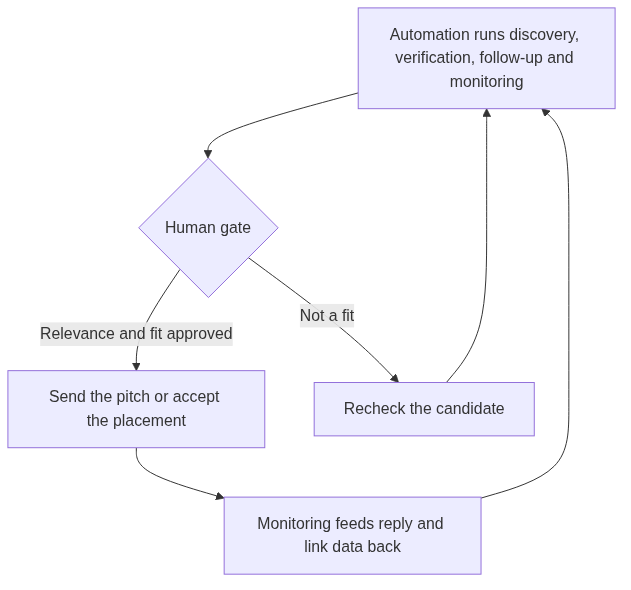
The answer to “can link building be automated?” is: the volume, yes; the judgment, no. A human-in-the-loop model formalizes that split so efficiency and quality don’t fight each other.
The hybrid model: automation owns the volume, humans own the quality
In a hybrid workflow, software owns discovery, verification, follow-up cadence, and monitoring. Humans own relevance review, content fit, relationship building, and risk audit. The automation feeds a human decision point at exactly the moments where quality is decided — before a send, before a placement, and when a monitoring alert fires. This is the same structure the market’s strongest services use: automation to accelerate, people to judge. For a deeper look at the compliant, quality-first side of this, see our guide to white hat link building.
The Automation Fit Check: four questions per step
Use these four questions to decide whether any given workflow step should be automated:
- Is it rule-driven? Is the step governed by repeatable, definable rules? Yes → automatable. No → needs a human.
- Is a mistake costly? Would an error here trip search engine guidelines or damage brand trust? High cost → keep a human gate.
- Does it need subjective judgment? Does it involve relevance, semantic fit, or relationship building? Yes → human owns it.
- Is there data feedback? Can you use data (reply rate, bounce rate, link monitoring) to keep improving? Yes → automate with a monitoring loop.
Run every stage through these four questions and the classification falls out naturally.
Automation platform vs. people-driven service: which fits you
The two approaches serve different situations, and choosing between them is really about your team’s capacity and priorities:
| Dimension | Automation marketplace | People-driven service |
|---|---|---|
| Core strength | Scale, tooling, self-serve selection | Strategy, quality judgment, relationship maintenance |
| Evidence | MeUp: 150k+ sites [1]; WhitePress: 26+ languages [2] | BaZoom: 80k+ channels, 4-day publish [3] |
| Automation payoff | Efficient volume, transparent data | Uses automation to audit, people to decide |
| Best for | In-house teams that want scale | Teams that want strategy alignment and compliance assurance |
| Risk | Can drift toward “marketplace” quality variability | Higher cost, depends on service quality |
Automation lifts efficiency in both models; it cannot replace the quality judgment that separates a good campaign from a risky one. That principle is exactly why a strategic partner — one that combines workflow efficiency with judgment — tends to outperform a pure self-serve tool for teams that care about compliance and long-term results.
Your Action Guide: Choosing What to Automate and What to Keep Manual
Here’s how to turn the framework into an actual rollout for your team, matched to your situation.
Scenario comparison: how much automation fits you
Small site / individual. Prioritize automating prospecting, email verification, and follow-up. Keep the final relevance review and message personalization manual. You get the biggest efficiency gain with the least setup.
Mid-to-large in-house team. Automate prospecting, verification, follow-up, and add a monitoring loop with alerts. Pair the automation with a strategy alignment process so the volume feeds a clear direction.
Agency. You need the hybrid: automation to deliver efficiency across many clients plus human quality gates, or you outsource the judgment-heavy work to a people-driven service for white-label and strategy support.
The pre-send checklist
Before you let any automation touch a real outreach campaign, run this checklist:
- Candidate sites have had a human relevance and authority review.
- Emails are verified and bounce rate is under control.
- Follow-up cadence and sending limits are set to avoid overwhelming recipients.
- Copy has been human-personalized, not sent as a raw template.
- The campaign complies with search engine quality guidelines (no purchased or bulk-created links).
- Link monitoring and anomaly alerts are configured.
The automation-fit decision matrix and rollout
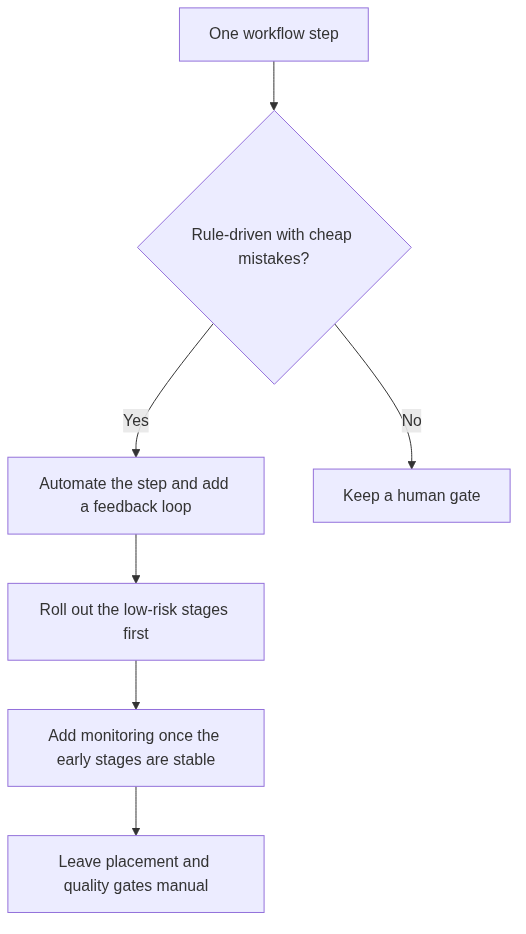
Start with the lowest-risk, highest-payoff stages first, then add the monitoring loop, and keep the final judgment manual:
| Workflow stage | Automation level | Human gate | Risk level |
|---|---|---|---|
| Prospecting | High | Final relevance review | Low |
| Contact discovery | High | Spot-check accuracy | Low |
| Email verification | High | Monitor bounce rate | Low |
| Outreach copy | Medium (AI-assisted) | Human rewrite and personalization | Medium |
| Follow-up | High | Set cadence and limits | Low |
| Monitoring / reporting | High | Human interprets anomalies | Low |
| Placing / purchasing links | Never automate | Full human + compliance review | High (red line) |
| Bulk-created low-value links | Never automate | Completely prohibited | Extreme (red line) |
Roll out prospecting, verification, and follow-up first. Once those are stable, add the monitoring loop so you’re alerted to changes. Keep the placement and quality gates manual from start to finish.
The Bottom Line: Automate the Volume, Keep the Judgment Human
Automated link building is a workflow strategy, not a backlink generator. The stages that are repetitive and rule-driven — prospecting, contact discovery, email verification, follow-up cadence, and monitoring — are where automation pays off. The stages that depend on relevance, fit, and relationships stay human, and the stages that touch quality guidelines are never automated at all.
The takeaway for your team
Speed up the repetitive steps, keep the placement and quality gates manual, and stay on the compliant side of the guidelines. If you follow the human-in-the-loop model, automation becomes a force multiplier instead of a risk. The highest-value results in link building still come from judgment on relevance, fit, and relationships — automation just frees your team to focus there.
When you want a strategic partner
If you’d rather hand the judgment-heavy work to a team that combines workflow efficiency with quality control, TraffiClimb’s Link Building Services operate as a strategic partner rather than a self-serve marketplace. We handle the volume and the judgment, so your team can focus on growth. We also keep every placement on the compliant side of search engine guidelines, so you can scale without second-guessing the boundaries.
FAQ
References
MeUp — link building platform — provides platform scale figures: 150,000+ reviewed sites and 80,000+ unique domains
WhitePress — global link building platform — provides platform coverage figures: operating across 26+ language markets since 2013
BaZoom — link building service agency — provides service figures: 80,000+ media channels and an average four-day publish turnaround