
Directory Link Building: How to Build Quality Backlinks From Relevant Directories
 Written by Alistair MacLeod

Every SEO has asked the same question at some point: is directory link building still worth the effort, or is it a relic of the Yahoo Directory and DMOZ era? The honest answer is that directory link building never disappeared — but it split into two very different practices. One is a legitimate way to earn relevant backlinks from curated directories. The other is a mass-submission shortcut that search engines now treat as a link scheme. This guide gives you a quality-first framework to tell the two apart, so you can earn directory backlinks that actually support a compliant link profile.
Is Directory Link Building Dead? The Question Every SEO Asks
The short answer: no, directory link building is not dead — but the version that used to work is. The practice that “worked” a decade ago — submitting to hundreds of generic free directories in a single afternoon — is exactly what search engines now flag. The real question isn’t whether directories have value. It’s whether you’re submitting to editorial directories that curate by topic, or to mass-submission directories that accept anyone who pays.
The mass-submission era is over — why “submit to 1,000 free directories” is now a link scheme target
Search engines have long treated bulk directory and bookmark-site submissions as a form of link manipulation [1]. When you submit your site to hundreds of directories that apply no review and no topical filter, you are not building a signal of relevance — you are generating low-value backlinks at scale. This behavior is precisely what link-quality guidelines describe as a link scheme, and it carries real risk if it’s detected during a manual review or a spam update [3]. The “submit to 1,000 free directories” playbook that circulated for years is now a liability, not a strategy.
The real question isn’t whether directories have value, but whether you’re submitting to editorial directories or mass-submission spam
Here is the distinction that matters. An editorial directory is curated by a human editor who reviews submissions against a content-quality and topical-relevance bar before approving anything. A mass-submission directory accepts listings automatically, usually for a fee, with no review and no relevance filter. When people say “directory backlinks don’t work anymore,” they are almost always describing the second category. The first category — niche, industry, and association directories with genuine editorial review — is a different resource entirely, and it still has a legitimate place in a compliant link profile.
Preview of the quality/relevance screening framework that drives this guide
The rest of this guide gives you a practical way to decide which directories deserve your time. You’ll learn a working definition of directory link building, the directory types worth pursuing, why relevance beats raw authority, a step-by-step submission process, and a scoring model you can apply before you submit anything. By the end, you’ll have a screening framework — not a list of “free directory sites.”
What Directory Link Building Really Is (and Isn’t)
To use directory link building correctly, you need a precise definition. Too many guides blur the line between a curated directory and a bulk-registration list, which is exactly how sites end up with a pile of low-value backlinks.
A working definition — curated, topic-categorized directories yielding editorial backlinks, not bulk registration
Directory link building is the practice of submitting your website to a curated directory that is organized by topic and reviewed by an editor, with the goal of earning an editorial backlink [2]. The emphasis is on editorial: the link is granted because your site meets the directory’s quality and relevance standards, not because you paid for instant approval. It is a deliberate, one-directory-at-a-time process. It is not bulk registration across dozens of generic directories.
The quality divide — editorial directories (human review, topical relevance) vs. mass-submission directories (no review, no relevance)
The entire value of directory link building rests on this divide:
| Dimension | Editorial directory | Mass-submission directory |
|---|---|---|
| Review mechanism | Human curation / editorial review | No review, instant approval |
| Acceptance bar | Topical relevance + content quality | Pay-to-list, no quality bar |
| Topical relevance | High (niche / industry / association) | Low (generic “free directory”) |
| Real audience | Genuine visitor traffic | Mostly crawler or low-value traffic |
| Link risk | Low (compliant) | High (link-scheme signal) |
| Typical example | Industry association directory, curated vertical resource | “Submit to 1,000 free directories” list site |
| Worth pursuing | Yes — part of a compliant link profile | No — actively exclude |
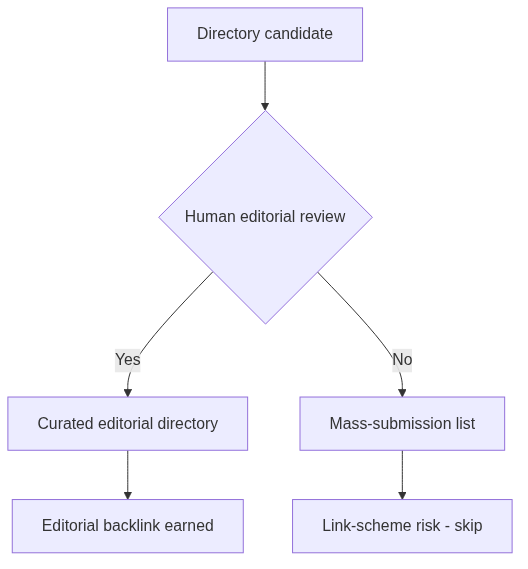
This is the core judgment you’ll apply throughout the guide: is this a curated resource with a human editorial bar, or an automated list that accepts anyone?
Boundary check — how directory link building differs from Local Citation (NAP consistency)
It’s also worth being clear about what this guide does not cover. Directory link building is not the same as local citation building. Local citations focus on name, address, and phone number (NAP) consistency across local business directories (like Google Business Profile, Yelp, and similar platforms) to support local map-pack rankings. Directory link building, as covered here, targets niche, industry, and association directories to earn topical editorial backlinks. The two can overlap, but they serve different goals and are out of scope for the full local-citation workflow.
The Directory Types Worth Pursuing: Niche, Industry, and Association
Not all editorial directories are equal. The ones that carry the strongest relevance signal are the ones tied to your specific market. That’s why the directory types below matter more than a generic high-authority listing.
Niche directories — vertical, topic-specific, and why inherent relevance beats generic high-DA pages
A niche directory is a vertical, topic-specific resource built around a single industry or interest (for example, a directory of SaaS tools, a directory of design agencies, or a directory of legal practices). Its inherent relevance is its main advantage. When your site appears in a directory that is entirely about your field, the topical signal is unambiguous — even if the directory’s authority metrics are modest. A niche directory link tells a search engine exactly what your site is about, which is far more useful than a generic link from a large but unrelated directory.
Industry and association directories — membership and professional bodies that signal editorial trust
Industry and association directories are maintained by professional bodies, trade organizations, and membership associations. Because these organizations typically vet their members, a listing carries an editorial-trust signal that a generic directory cannot replicate. If your business qualifies for membership in a relevant professional body, a directory link from that association is usually worth far more than a link from a high-authority but unrelated site. These directories are the closest thing to a third-party endorsement that directory link building offers.
Relevant business directories — curated commercial listings that pass the editorial review test
There are also curated commercial business directories that apply genuine editorial review before publishing a listing. The key is that they pass the editorial test: a human reviews the submission, there is a content-quality bar, and the directory is organized around a relevant category. A relevant business directory link that clears this bar can be a useful part of a balanced link profile — but only if it genuinely meets the relevance and editorial criteria, not because it has a high authority score.
Why Relevance Beats Domain Authority in Directory Selection
One of the most common mistakes in directory link building is choosing directories by authority score instead of by relevance [2]. The metric that matters most is whether the directory’s audience and topic align with yours.
The “high DA but zero relevance” trap — why a generic high-authority directory underperforms a relevant mid-tier one
It’s tempting to chase directories with the highest domain authority, assuming a bigger number means a better link. But a generic directory with high authority and no topical connection to your business is a weak relevance signal. A mid-tier directory that is entirely about your industry, with a real audience of people who care about that topic, delivers a stronger signal for your specific site. Relevance is the primary lens; authority is a secondary consideration that only matters once relevance is established.
Traffic and relevance as the primary signals — real audience vs. crawler/low-value traffic
When you evaluate a directory, ask whether it has real audience traffic or just crawler traffic that inflates the numbers. A directory that people actually visit for your topic is valuable because it exposes your site to the right audience and passes a genuine relevance signal. A directory whose “traffic” is mostly bots, or whose visitors are unrelated to your niche, contributes little. Traffic quality and topical match are the signals that matter, not a vanity authority metric.
The editorial review signal — how human curation adds genuine relevance
The editorial review is what separates a compliant directory link from a low-value one. When a human editor decides your site belongs in a topic-specific directory, that decision is a form of curation that search engines can interpret as a relevance signal. This is why the industry’s leading link-building platforms treat “reviewed sites” as their core asset — curation is the mechanism that makes a directory link meaningful in the first place.
Directory Submission as a Quality Filter: A Step-by-Step Process
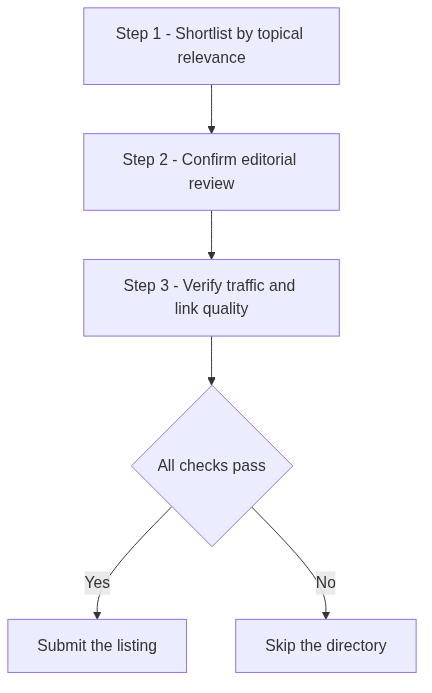
If you treat directory submission as a quality filter rather than a volume task, the process becomes straightforward. Here is the order in which you should evaluate and submit.
Step 1 — Build a shortlist of candidate directories by topical relevance, not volume
Start by listing directories that are genuinely relevant to your niche, industry, or association membership. Resist the urge to widen the list to hit a target number. A shortlist of ten highly relevant editorial directories is worth more than a list of a hundred generic ones. Relevance is the first filter, and it should eliminate most candidates before you ever consider a submission.
Step 2 — Run the editorial review check and confirm human curation before any submission
Before you submit, verify that the directory actually applies editorial review. Look for signs of human curation: a stated submission policy, a review process, category organization, and a quality bar for inclusion. If the directory accepts anyone instantly for a fee with no review, remove it from your list. The editorial-review check is the single most important filter in the entire process.
Step 3 — Verify real audience traffic and link quality (dofollow/nofollow, anchor profile) before finalizing
Finally, confirm that the directory has real audience traffic and that its link profile is healthy. Check whether the link will be dofollow or nofollow, whether the directory’s anchor text is natural, and whether the surrounding outbound links look like spam. A relevant editorial directory with clean link hygiene is worth submitting to; a directory whose outbound profile is full of low-value links is a risk regardless of its stated quality.
Practical Application and Action Guide: Screening Check and Scoring Model
Theory is useful, but you need something you can apply. This section gives you a screening checklist and a scoring model you can run before every submission.
The 6-point Directory Submission Screening Checklist — pass every item before you submit
Run through all six points below before submitting to any directory. If any item fails, skip it.
- Editorial review — Does the directory have a human review or curation process? (Yes = pass; no review, pay-to-list = skip)
- Topical relevance — Is the directory’s category directly related to your business or content topic? (No = skip)
- Real traffic — Does the directory have genuine audience visits, not pure crawler traffic? (Unverifiable or clearly low-value = skip)
- Acceptance bar — Is there a content-quality threshold or editorial selection standard? (No bar = high risk)
- Link quality — Is the link dofollow or nofollow, and is the directory’s outbound profile clean? (Messy anchor text or spam-heavy = skip)
- Historical risk — Does the directory appear on “free directory bulk submission” lists or get flagged as spam by the community? (Yes = skip)
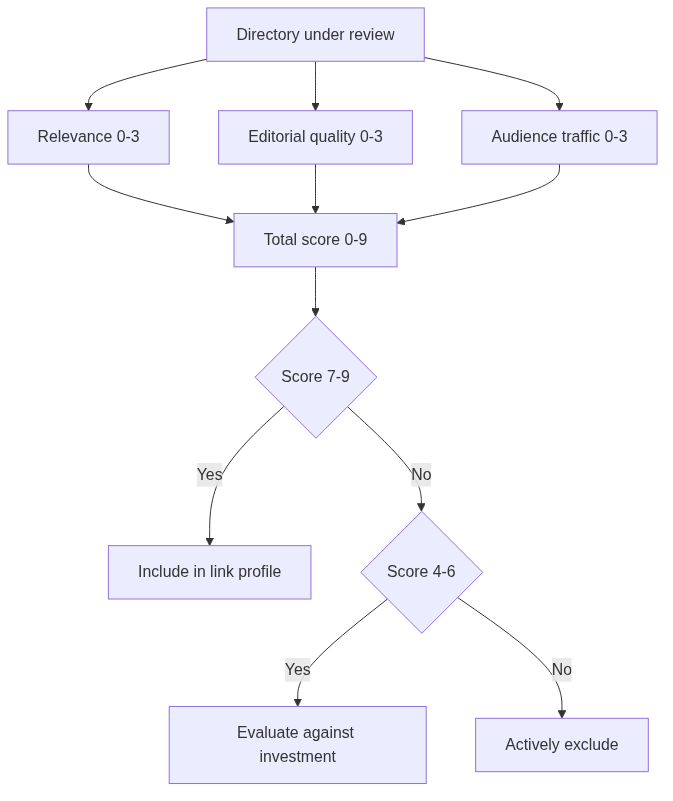
The three-dimension directory value score (Relevance / Editorial Quality / Audience Traffic, 0–9) and how to act on it
Score each directory on three dimensions, from 0 to 3 per dimension, for a total between 0 and 9:
- Relevance (0–3): how closely the directory’s topic matches your niche.
- Editorial Quality (0–3): the strength of human review and the content bar.
- Audience Traffic (0–3): whether the directory has real, relevant visitor traffic.
Then act on the total score:
| Score | Action |
|---|---|
| 7–9 | Include in your compliant link profile |
| 4–6 | Evaluate carefully against resource investment |
| 0–3 | Actively exclude |
Scenario comparison — editorial vs. mass-submission directories, and the real cost of mass submission
Here is the practical difference between the two approaches in a single table:
| Dimension | Editorial directory (submit) | Mass-submission directory (avoid) |
|---|---|---|
| Time per directory | High — research, review, craft submission | Low — automated bulk submission |
| Relevance signal | Strong | Weak or absent |
| Compliance risk | Low | High — link-scheme signal |
| Real audience value | Yes | Mostly none |
| Impact on overall profile | Positive, sustainable | Can undermine other compliant work |
The real cost of mass submission isn’t just wasted time. A spike of low-value directory backlinks can draw manual review attention and undermine the compliant links you’ve worked to build [3]. When you weigh the risk against the near-zero relevance benefit, mass submission is a losing trade.
Core Conclusion and Next Steps: Build a Quality-First Link Strategy
By now the picture should be clear. Directory link building is not a volume game, and it never should have been treated as one.
Recap — directory backlinks still earn a place, but only the editorial, relevant ones do
Directory backlinks still have a legitimate place in a link profile — but only the editorial, relevant ones. The directories that add value are curated, topic-specific, and reviewed by humans. The directories that add risk are the automated, pay-to-list, generic ones. Everything in this guide points back to the same principle: quality and relevance first, volume never.
The takeaway — one relevant editorial directory link outperforms a pile of mass submissions
The practical takeaway is simple. One relevant editorial directory link, earned through a genuine review process, carries more value than dozens of mass-submitted generic links. When you build your link profile around that principle, you avoid the compliance risk that sinks so many directory campaigns and you keep every link aligned with your actual topical authority.
CTA — move from picking directory links to a quality-first link building strategy
Choosing the right directory links is a useful skill, but it’s only one part of a broader, quality-first link building strategy. If you want to move beyond picking individual directories and build a link profile that supports sustainable organic growth, a strategic approach makes the difference. At TraffiClimb, we build compliant, content-driven backlink strategies for sites that want to rank for the right reasons. Explore our link building strategies and learn what makes a high-quality backlink — then request a consultation to discuss a quality-first plan for your site.
FAQ
References
Google Search Central — Link spam policies — describes how bulk directory and bookmark submissions are treated as link schemes, supporting the mass-submission risk framing in H2 1
Moz — Directory Link Building — explains the distinction between editorial and low-value directories and the role of relevance, supporting the definition and relevance-first framework
Google Search Central — Link schemes — clarifies which link-building behaviors are classified as link manipulation, supporting the compliance-risk judgment in the scenario comparison