
Crypto Link Building: Strategies, Quality Signals, and Risks
 Written by Warren Reed

Link building for crypto projects looks nothing like link building for a typical B2B SaaS site. The publisher environment is more polarized, the trust stakes are higher, and the same “high-DR link” that would be a win in another industry can become a liability in crypto. This guide walks through the crypto link building environment, the quality signals that actually matter, the high-risk patterns to avoid, and a practical decision framework you can apply before you send a single outreach email.
Why Crypto Link Building Is a Different Game
Crypto link building operates under a different set of pressures than most industries, and treating it like a standard link acquisition playbook is a fast way to accumulate risk. The core difference is that a backlink in crypto carries weight beyond SEO—it becomes part of how users, investors, and platforms judge your credibility.
The high-DR trap — why a “strong” link can be a liability in crypto
In most niches, a high Domain Rating site with real traffic is a reasonable quality signal. In crypto, a high-DR metric alone tells you very little. Many crypto-adjacent publishers have inflated authority scores but weak editorial governance, accepting paid posts with minimal review. A link from such a site can look strong in an SEO tool while simultaneously signaling to search engines that your brand buys placements, and signaling to readers that your project pays for coverage. When the same URL is later penalized or flagged as a link network, your site inherits the association. The metric that matters is not the number in the dashboard but whether the link is editorially earned and contextually relevant.
Three forces that make crypto link building unique: publisher trust, spam-link risk, and regulatory overlap
Three forces combine to make crypto link building genuinely different. First, publisher trust is scarce: authoritative crypto media and vertical publications are selective about who they cover, and they have to be, because their own credibility is on the line. Second, spam-link risk is amplified: paid-post farms and link networks are common in crypto, which means search engines apply stricter scrutiny to the neighborhood your backlinks come from. Third, regulatory overlap surfaces in some jurisdictions, where promotional activity around crypto assets draws additional attention from regulators and platforms—so a placement that is merely low-effort can also carry compliance implications. These three forces push crypto link building away from volume and toward verification.
What this guide covers and what it deliberately does not
This is a decision framework, not a shopping list. You will not find a list of sites to buy links from, and you will not find token investment advice or a regulatory playbook. What you will find is a way to judge publishers, evaluate providers, and recognize high-risk patterns before they become problems. The goal is to help you build crypto link building on a foundation that stays durable when algorithms and platform policies shift.
The Crypto SERP and Publisher Environment
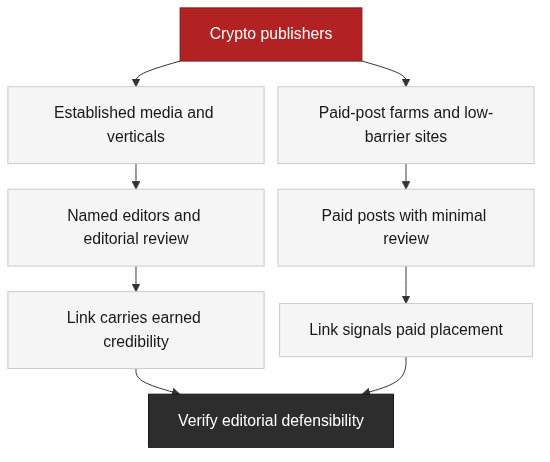
The crypto SERP sits on a polarized publisher ecosystem, and understanding that split is the first step to building links that hold value. On one side you have established media and vertical outlets with real editorial processes; on the other, a long tail of low-barrier, paid-post farms that will publish almost anything for a fee.
A polarized publisher ecosystem — authoritative media vs. low-barrier paid-post farms
The practical reality is that crypto publishers fall into two very different camps. Authoritative outlets have named editors, editorial guidelines, and a reputation to protect; they are hard to place on, and that difficulty is exactly why a link from them carries weight. Paid-post farms, by contrast, are easy to place on precisely because they accept nearly any submission with a payment. The signal you want is not ease of placement but editorial defensibility. When a reader or an algorithm asks “why does this site link to this project?”, the answer should be “because the content earned it,” not “because the project paid for it.”
Stricter editorial review and content governance in search and platform policies
Search engines apply higher standards to content that can affect a person’s financial wellbeing, and crypto content frequently falls into that category. Google’s spam policies explicitly treat paid links, link networks, and low-quality directories as violations, and its guidance on “Your Money or Your Life” topics signals that financial content is held to a stricter bar than general content [1][2]. Platform policies around crypto and financial promotion add another layer. The takeaway for crypto link building is that editorial review is not a hurdle to work around—it is the mechanism that keeps your links credible in the first place.
Why link value depends on publisher credibility and relevance, not just DR or traffic
The value of a crypto backlink is a function of the publisher’s credibility and topical relevance, not its raw authority score. A link from a respected crypto-focused publication that covers your actual product category is worth more than a link from a high-DR general site that has never mentioned blockchain before. Relevance tells search engines and readers that the endorsement is meaningful; credibility tells them it is trustworthy. When you evaluate a candidate, ask what the site actually stands for, who reads it, and whether a genuine editorial relationship is plausible.
Trust and Reputation as the Currency of Crypto Backlinks
In crypto, a backlink is not just an SEO signal—it is a reputation endorsement. Readers and platforms interpret who links to you as a statement about who vouches for you, which makes quality and context inseparable from the link itself.
Backlinks as reputation endorsements, not just SEO signals
A single authoritative link can do more for trust than dozens of weak ones, because it signals that an independent editorial team evaluated your project and chose to reference it. Conversely, a link from a disreputable source can do real damage, because it associates your brand with the source’s reputation. This is why crypto link building should be treated as reputation management with an SEO component, not the reverse. Every placement is a public association, and associations are hard to undo.
High-value trust pathways — Digital PR, data and research assets, expert commentary
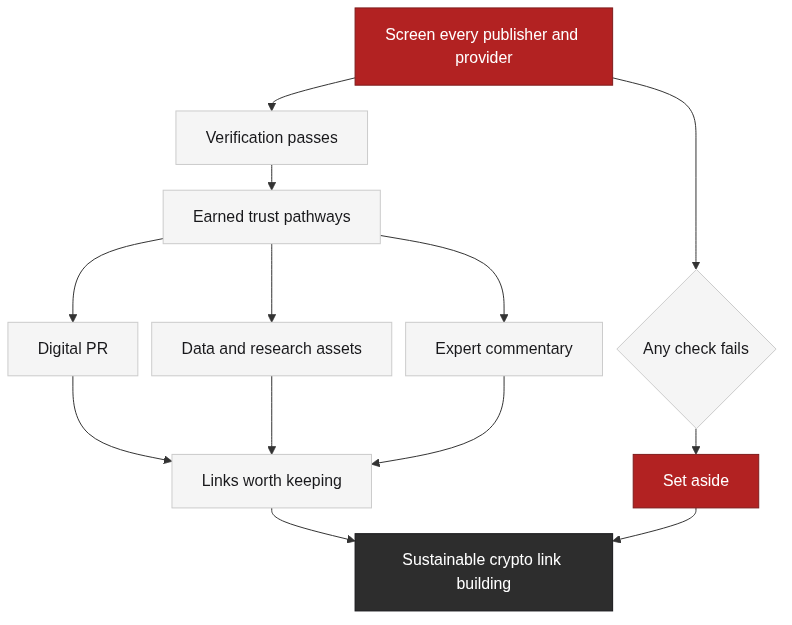
Three pathways consistently build durable trust in crypto. Digital PR earns coverage by giving journalists a genuine story—a product milestone, a market observation, a founder perspective—rather than a pitch to place a link. Data and research assets give outlets something original to cite: original analysis of on-chain activity, market trends, or user behavior that is genuinely useful and verifiable. Expert commentary positions your team as a source that journalists can quote on industry topics, which tends to produce natural editorial links over time. All three share a common trait: they earn links by being worth referencing, which is the opposite of buying placements.
Community and editorial opportunities that build durable credibility
Crypto has a dense ecosystem of communities, forums, newsletters, and independent editorial voices that are often more influential than mainstream coverage. Engaging genuinely with these spaces—contributing useful analysis, answering questions, sponsoring transparent research—builds credibility that compounds. The key is that these opportunities reward substance over self-promotion. A project that consistently shows up with useful information accumulates the type of trust that no purchased link can replicate.
High-Risk Patterns to Recognize and Avoid
A mature crypto link building strategy is as much about what you refuse to do as what you do. Certain patterns amplify risk disproportionately in crypto, and recognizing them early is part of the strategy itself.
Why PBNs, paid placements, and low-quality sites amplify risk in crypto
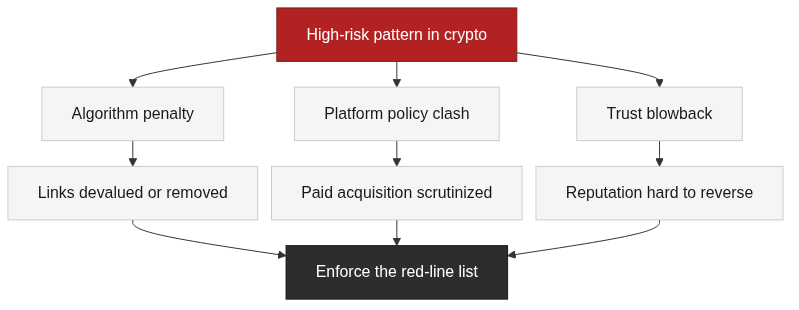
Private blog networks, bulk paid placements, and low-quality directories are risky in any industry, but crypto amplifies the downside. These patterns are heavily targeted by search spam policies, which explicitly call out link networks and paid links as violations [1]. In crypto, the same risky link can hurt you three ways at once: it can trigger an algorithm penalty, it can clash with platform advertising policies that restrict crypto promotion, and it can erode user trust when readers recognize the placement for what it is. The cost of a single bad link in crypto is rarely just the link itself.
Algorithm penalties, platform policy clashes, and trust blowback
The damage from high-risk patterns compounds across three fronts. Algorithm penalties can devalue or remove the affected links, and in severe cases affect the whole site’s visibility. Platform policy clashes matter because crypto projects often rely on paid acquisition channels; a link profile full of bought placements can create inconsistencies that platforms scrutinize. Trust blowback is the hardest to quantify and the hardest to repair—once readers or partners perceive that your brand buys credibility, the perception is difficult to reverse. In crypto link building, the downside of shortcuts is disproportionately large relative to the upside.
The “what not to do” red-line list as part of strategy
A clear red-line list turns risk avoidance into a repeatable decision rule. In crypto, that list should include: no buying backlink lists or bulk ordering paid posts; no private blog networks, link farms, or low-quality directories; no investment advice disguised as content; and no fabricated claims about your own track record or publisher relationships. Writing these down and enforcing them internally is what separates a sustainable approach from an opportunistic one.
Market and Geographic Considerations
Crypto is a global market, but it is not a uniform one. Where your audience sits—and where your publishers sit—shapes which links are worth pursuing and which carry avoidable risk.
Regulatory differences across jurisdictions and their practical implications
Regulatory treatment of crypto promotion varies significantly by jurisdiction, and the differences have practical implications for link building. In some markets, promotional claims about crypto assets draw closer regulatory and platform scrutiny; in others, the environment is more permissive. This is a general background consideration, not a substitute for legal advice—verify the specifics for your markets with qualified counsel before building promotional campaigns around regulated claims. The practical point is that a placement that is unremarkable in one jurisdiction can raise questions in another, so geography belongs in your due diligence.
Aligning publisher geography with target audience distribution
The publishers you target should reflect where your actual audience lives, not just where the highest-DR sites happen to be. A crypto project serving a specific region gains more from relevant regional coverage than from scattered global placements that no one in your target market reads. Aligning publisher geography with audience distribution improves both relevance and credibility—the link reaches the right people in the right context.
Using competitor analysis to benchmark realistic opportunities
Competitor analysis helps you benchmark what is realistic rather than aspirational. Look at where credible competitors earn coverage, which publishers consistently reference projects in your space, and what kinds of content assets tend to attract links. This gives you a map of achievable opportunities and a sense of the editorial standards you need to meet. It also reveals patterns to avoid—if competitors are accumulating low-quality placements, that is a signal about the risk they are carrying, not a model to copy.
A Decision Framework for Sustainable Crypto Link Building
Sustainable crypto link building comes down to repeatable decisions: what to verify, whom to trust, and what path to prioritize. The framework below turns those decisions into concrete checks.
Publisher screening checklist — verify before you send or buy
Before investing in any placement, run every candidate through a verification checklist:
A candidate that fails any of these checks should be set aside, regardless of its authority metrics.
- Does the site have a real, identifiable editorial team and a visible content governance process?
- Does the site accept large volumes of paid posts, and are sponsored or advertising placements clearly labeled?
- Is the content relevant to your crypto product and does the audience match your target market?
- Does the site show signs of being a link network, link farm, or low-quality directory—such as no real readership, templated content, or abnormal interlinking?
- What is the site’s history—has it been penalized by search engines or restricted by platforms?
- Is the link earned editorially, or is it a paid placement?
- Does the site’s geographic and regulatory context align with your target markets and compliance posture?
Provider evaluation dimensions — compliance, content quality, data transparency, relevance, sustainability
If you work with an external link building provider, evaluate them on the same standards you would apply to a publisher. Assess compliance transparency—do they openly explain how placements are obtained, and do they avoid paid posts and link networks? Assess content quality—do they produce original, editorially valuable content rather than templated posts? Assess data transparency—do they provide verifiable placement reports with real URLs? Assess relevance—is their publisher network actually topical to crypto, or is it a generic site network? Finally, assess sustainability—is their strategy built for the long term, or is it a one-time volume push? The right provider looks like a partner, not a link farm in disguise.
Scenario comparison — high-intent traffic vs. brand trust vs. volume paths
Different goals call for different paths, and knowing which one you are on prevents wasted effort:
Most sustainable crypto link building blends these paths, prioritizing trust and relevance while using volume only where it genuinely supports the goal.
| Goal | Typical path | Primary risk | How to measure |
|---|---|---|---|
| High-intent traffic | Authoritative media, vertical outlets, expert commentary | High cost, high barrier to entry | Referral traffic, conversions |
| Brand trust and endorsement | Digital PR, data and research assets, community and editorial opportunities | Long cycle, harder to quantify | Brand searches, mentions, citations |
| Volume growth | Native content insertion, conventional outreach | Low quality, value decays quickly | Link counts, authority metric changes |
Core Takeaways and Your Next Step
The difference between sustainable crypto link building and risky shortcuts comes down to a small number of decisions. Make them deliberately, and the rest of the work becomes execution.
The three decisions that separate sustainable crypto link building from risky shortcuts
Three decisions carry most of the weight. First, choose verification over convenience—screen every publisher and provider rather than trusting metrics alone. Second, prioritize earned trust over volume—invest in Digital PR, research assets, and genuine editorial relationships that produce links worth keeping. Third, treat risk avoidance as strategy—maintain a red-line list and enforce it, because in crypto the cost of one bad link is disproportionately high.
Where to start — an educational, compliance-first roadmap for your team
Start by auditing what you already have. Run your current link profile through the publisher screening checklist and the provider evaluation dimensions, and identify any placements that would fail. Then build a short list of credible publishers in your actual market that you could realistically earn coverage from, and prepare the type of content assets—research, analysis, expert perspective—that those outlets would genuinely want to reference. This compliance-first roadmap keeps you moving without accumulating risk.
Next step — evaluate your current link profile against this framework before adding anything new
Before you add a single new link, evaluate what already exists against this framework. Remove or disavow anything that fails the screening checklist, and use the scenario comparison to confirm which path your next campaign should take. For a deeper grounding in the underlying practices, explore how to identify relevant backlinks that support your goals, what makes a backlink genuinely high-quality, and how white hat link building and Digital PR fit into a sustainable strategy. When you are ready to think about execution, review the risks of PBN backlinks and how to approach outsourcing link building with the right evaluation criteria.
FAQ
References
Google Search Central — Spam policies: documents that search engines treat paid links, link networks, and low-quality directories as spam violations, which supports the discussion of high-risk patterns in crypto link building. https://developers.google.com/search/docs/essentials/spam-policies
Google Search Central — SEO starter guide and quality guidance: explains that content affecting financial wellbeing is treated with higher review standards (YMYL), supporting the discussion of stricter editorial review for crypto content. https://developers.google.com/search/docs/fundamentals/seo-starter-guide
Google Search Central Blog — Evolving “nofollow”: new ways to identify links: documents how search engines treat paid and sponsored links through rel=”sponsored” and rel=”ugc” attributes, supporting the discussion of paid placements and link credibility in crypto link building. https://developers.google.com/search/blog/2019/09/evolving-nofollow-new-ways-to-identify