
Sponsored & UGC Link Attributes: When to Use rel=”sponsored”, rel=”ugc”, and Nofollow
 Written by Alistair MacLeod

Every outbound link on your site carries a signal about how much you vouch for it. When you run a sponsored post, an affiliate placement, or a comment section, the rel attribute you choose tells Google whether that link exists because of money, because of user contributions, or because you genuinely want to stand behind it. Get the markup wrong on a paid link, and you hand Google a reason to treat it as a link scheme. This guide walks through the rel ugc, rel="sponsored", and nofollow attributes, when each one applies, and how to mark up real-world links without guesswork.
Why Your Outbound Link Markup Matters More Than You Think
Sponsored & UGC link attributes decide how Google reads every outbound link you publish. A single mislabeled outbound link rarely sinks a site by itself. But a pattern of paid links marked as ordinary dofollow is exactly the signal Google’s spam systems are built to detect. When a site sells a link for ranking purposes and fails to flag it, that placement can be read as an attempt to manipulate PageRank — and the consequences can ripple across the whole domain rather than staying isolated on one page.
The question every site operator should ask is simple: Is every outbound link on your site using the correct rel attribute? Correct markup is not a nice-to-have detail; it is the compliance baseline that keeps sponsored content, affiliate placements, and user-generated sections from being misread as manipulative.
Here is the path this guide follows: first we define the three rel values and what each one means, then we map outbound link scenarios to the right attribute, then we cover combination rules with ready-to-use HTML, and finally we give you a checklist you can reuse before every publish.
The Three rel Attributes: nofollow, sponsored, and ugc Defined
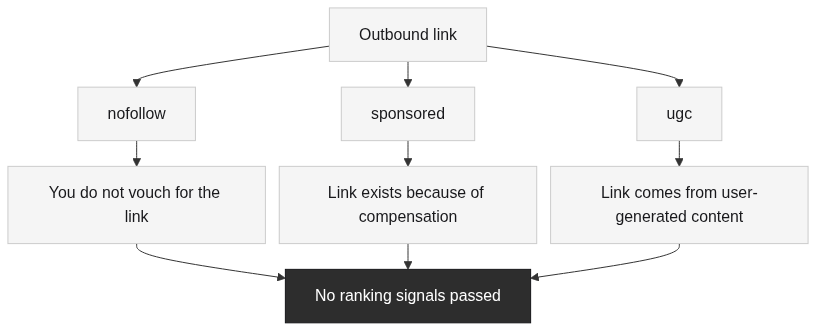
Google introduced sponsored and ugc as distinct rel values in September 2019, joining the long-standing nofollow value to create a three-way classification for outbound links [3]. Each one answers a different question about why a link exists.
rel=”nofollow” — The Don’t-Vouch Default
rel="nofollow" tells Google you do not vouch for the linked page. Google does not pass PageRank or ranking signals through a nofollow link, though it still crawls the link to discover content [1]. This is the safe default when you are not sure how to classify a link, or when you simply do not want to endorse it.
rel=”sponsored” — Paid, Sponsored, and Affiliate Links
rel="sponsored" marks links that exist because of compensation — money, gifts, exchanges, or any other form of payment [1]. This covers sponsored content, affiliate links, paid placements, banners, and resource placements where the link appears because of a commercial arrangement.
rel=”ugc” — Links Inside User-Generated Content
rel="ugc" marks links that appear in user-generated content: forum posts, comment sections, blog comments, wiki edits, and Q&A communities [1]. The attribute tells Google this link came from a user contribution rather than from editorial content you authored and control.
The Three Attributes Compared
| Dimension | nofollow |
sponsored |
ugc |
|---|---|---|---|
| Core meaning | You do not vouch for this link | Link exists because of compensation | Link lives inside user-generated content |
| Typical scenario | Uncertain, don’t vouch, safe default | Affiliate, sponsored, paid placement | Forum, comment, blog comment, Q&A |
| Passes PageRank | No | No | No |
| Can combine with other values | Yes | Yes | Yes |
| Old links need rewriting | No | New links should use it | New links should use it |
When to Use rel=”ugc” vs rel=”sponsored” vs Nofollow
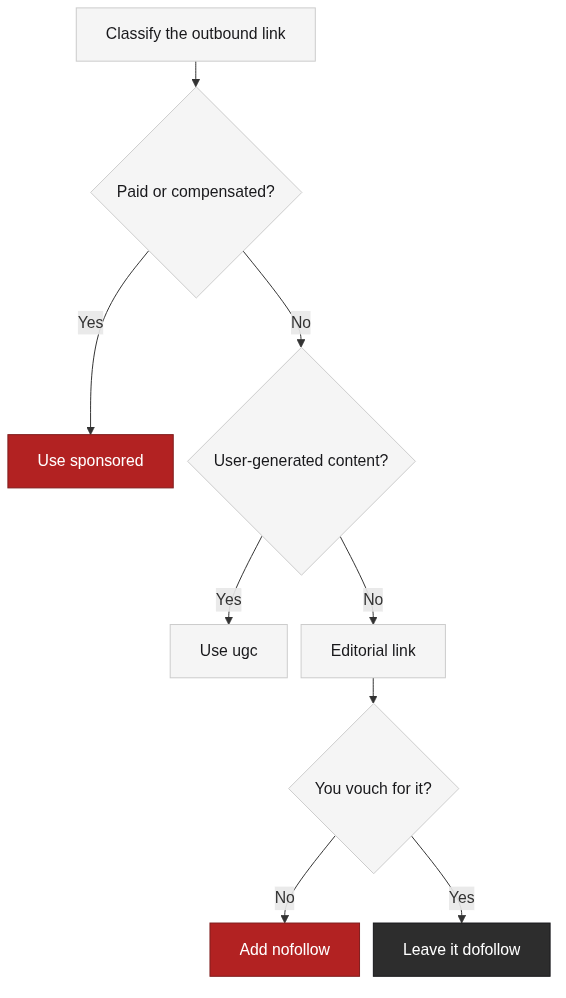
The decision rarely comes down to memorizing definitions. It comes down to two quick questions about the link in front of you: did it exist because of payment, and did it come from a user? The answers point you to the right attribute almost every time.
A Decision Matrix for Outbound Links
| Outbound link scenario | Paid / compensated? | User-generated? | Recommended rel markup |
|---|---|---|---|
| Natural outbound link in editorial content (citation/reference) | No | No | None (dofollow) |
| Affiliate / referral link | Yes | No | rel="sponsored" (can add nofollow) |
| Sponsored article / paid placement / banner | Yes | No | rel="sponsored" |
| Forum post / comment-section link | No | Yes | rel="ugc" (can add nofollow) |
| Blog comment / Q&A community link | No | Yes | rel="ugc" |
| Link you are unsure how to classify | — | — | rel="nofollow" |
Why Paid Content Must Use rel=”sponsored”
Search engines treat the sale of links for ranking purposes as a violation of spam policies [2]. The official guidance is direct: if you are selling a link for ranking purposes, that is a violation of Google’s spam policies [2]. rel="sponsored" is the mechanism that discloses the commercial nature of the link so Google can interpret it correctly instead of flagging it as manipulation. Affiliate links, sponsored articles, and paid placements all fall into this bucket.
Why Forums, Comments, and Q&A Use the rel ugc Attribute
User-generated content is a different animal. When a reader drops a link in a comment or a forum member posts a link in a thread, you did not author that content, and you cannot fully control what appears. The rel ugc attribute tells Google this link came from a user contribution, letting it separate editorial authority from user-submitted links [1]. It is the honest signal for anywhere users can post links on your site.
Editorial Natural Links Stay Dofollow
A natural outbound link you place yourself — a citation, a reference, a genuinely useful resource — carries no payment and no user contribution. It needs no rel markup at all. Leaving it as a standard dofollow link is both correct and the default behavior that signals genuine endorsement. This is where the distinction between vetted editorial links and everything else lives.
Combining rel Values and Ready-to-Use HTML Examples
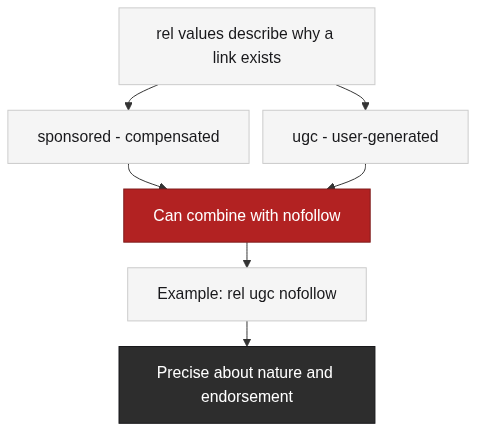
The three rel values are not mutually exclusive. Google explicitly allows combining them, so rel="ugc nofollow" and rel="sponsored nofollow" are both valid [1]. Combining lets you be precise about both the nature of the link and whether you vouch for it.
Combination Rules
- – Multiple values are allowed.
rel="sponsored nofollow"marks a paid link you also do not vouch for. - –
ugcandsponsoredare not replacements fornofollow. They describe *why* a link exists;nofollowdescribes whether you vouch for it. They answer different questions and can coexist. - – Order does not matter. Google reads the set of values, not their sequence.
Affiliate Link HTML Example
<!-- Affiliate link, compensated -->
<a href="example.com/tool" rel="sponsored">Check out this tool</a>

<!-- Affiliate link, compensated and not vouched for -->
<a href="example.com/tool" rel="sponsored nofollow">Check out this tool</a>
Comment, Forum, and Blog Comment HTML Example
<!-- User-submitted link in a comment section -->
<a href="example.com/resource" rel="ugc">A resource shared by a reader</a>

<!-- User-submitted link, not vouched for -->
<a href="example.com/resource" rel="ugc nofollow">A resource shared by a reader</a>
Copy-Paste Code Blocks for Real Scenarios
Sponsored article with an outbound link:
<p>This post was sponsored by Example Brand.</p>
<a href="example.com/offer" rel="sponsored">View the sponsored offer</a>
Comment section with a user link:
<div class="comment">
  <p>Thanks for this guide! Related reading:</p>
  <a href="example.com/guide" rel="ugc nofollow">Related guide</a>
</div>
Forum thread with a member link:
<div class="forum-post">
  <p>I found this comparison helpful:</p>
  <a href="example.com/compare" rel="ugc">Comparison page</a>
</div>
Do Old Nofollow Links Need to Be Rewritten?
Short answer: no, not as a blanket requirement. Google has been clear that existing nofollow links do not need to be rewritten just because sponsored and ugc now exist [1]. nofollow remains fully valid. The new attributes are a more precise classification, not a forced replacement.
Google’s Official Position
Google’s position is that you are not required to go back and change every existing nofollow link [1]. The nofollow value still works exactly as it always has. The introduction of sponsored and ugc gave site owners more accurate ways to describe new links, but it did not invalidate the old ones.
sponsored and ugc Are More Precise Classifications, Not Replacements
Think of nofollow as a broad “I do not vouch for this” bucket. sponsored and ugc are narrower buckets that tell Google *why* a link should not pass endorsement. They add information nofollow does not carry. That makes them better choices for new paid and user-generated links, but it does not make existing nofollow markup wrong.
When Rewriting Is Worth It
Rewriting old links makes sense in specific situations: high-traffic template pages like footers or sidebars, blocks of paid or UGC links you are actively managing, and cases where the change is easy to make. If a template renders the same nofollow link across hundreds of pages, upgrading it to rel="sponsored" or rel="ugc" improves markup precision at low cost.
When It Is Not Worth the Effort
For scattered, low-value, or high-effort historical links, leave the nofollow in place. Google does not require the change, and the effort is better spent marking new links correctly going forward. Precision on future links matters more than retrofitting every old placement.
A Practical Checklist for Correct Link Markup
Before you hit publish, run each outbound link through a three-step check. It takes seconds and catches the most common mistakes.
A Three-Step Pre-Publish Check
- 1. Is this link paid, sponsored, gifted, exchanged, or otherwise compensated?
- – Yes → use
rel="sponsored"(addnofollowif you also do not vouch for it). - – No → move to step 2.
- 2. Is this link inside user-generated content (forum, comment, blog comment, wiki, Q&A)?
- – Yes → use
rel="ugc"(addnofollowif you also do not vouch for it). - – No → move to step 3.
- 3. Do you want to vouch for this link?
- – Yes → leave it as a standard
dofollowlink (norelmarkup). - – No or unsure → use
rel="nofollow"as the safe default.
Common Markup Mistakes to Avoid
- – Paid links left unmarked. An affiliate or sponsored link without
rel="sponsored"is the highest-risk mistake because it looks like a link scheme [2]. - – UGC links left unmarked. Forums and comments that strip or omit
rellose the signal that the content is user-generated. - – Assuming sponsored/ugc “penalize” a link. These attributes are descriptive, not punitive. They clarify the link’s nature; they are not a penalty.
- – Assuming sponsored/ugc cannot combine with nofollow. They combine freely, and combining is often the correct choice.
Applying the Matrix to Your Site
Print the decision matrix and keep it next to your publishing workflow. Once the three-step check becomes routine, correct rel markup stops being a decision and becomes a habit. The same matrix works whether you manage a small blog, a content-heavy site, or a set of client pages.
Core Takeaways and Your Next Step
Correct rel markup is the foundation of a compliant, transparent, and sustainable link strategy. It is not about gaming the system — it is about giving search engines accurate information so your editorial links, paid placements, and user-generated content are each read the way they should be.
The Core Conclusion
Three values answer three questions. nofollow says you do not vouch for a link. sponsored says a link exists because of compensation. ugc says a link lives inside user-generated content. Use them precisely, combine them when needed, and you remove a whole class of compliance risk from your site.
Your Next Step
Start today by auditing your most visible outbound links — the ones in templates, sponsored posts, and comment sections. Run each one through the three-step check, fix the mistakes, and adopt the matrix as your standing markup rule. You do not need to rewrite every historical link; you just need to mark new ones correctly from now on.
Further Reading
- – Dofollow vs Nofollow Links: What Actually Matters — the baseline distinction this guide builds on.
- – Paid Backlinks: What to Know Before You Buy — the risk side of compensated links.
- – White Hat Link Building: A Sustainable Approach — building links the compliant way.
- – Types of Backlinks: Which Ones Move the Needle — how different links contribute to growth.
FAQ
References
Google Search Central — Link best practices (Qualify outbound links) — Defines the nofollow, sponsored, and ugc values, their use cases, combination rules, and the guidance that existing nofollow links need no rewriting.
Google Search Central — Link schemes (Spam policies) — Provides the official position that selling links for ranking purposes violates spam policies and explains why paid links must be marked.
Google Search Central Blog — Evolving “nofollow”: New ways to identify links — Documents the September 2019 introduction of the sponsored and ugc values alongside nofollow.