
Reactive PR: A Complete Guide for Fast, On-Brand Media Response
 Written by Sanja Gajic

A major algorithm update lands on a Tuesday morning. A regulator drops a new rule your industry has been expecting for months. A reporter covering your sector posts a request for expert commentary and a data point to back it up. Within hours, journalists are scanning for sources that can respond quickly, credibly, and on-message.
This is the world of Reactive PR — the discipline of responding to real-time media opportunities the moment they appear. It is not about waiting for a pitch to be accepted on your own timeline. It is about having a response system ready before the opportunity exists, so that when the window opens, you are one of the first credible voices a reporter can cite.
In this guide, you will learn what Reactive PR actually is (and what it is not), how it differs from proactive PR and from newsjacking, the four opportunity types your team should watch, a six-step rapid-response workflow, and the qualification, risk, and measurement framework that keeps fast responses on-brand.
What Is Reactive PR? The Opportunity That Fades in Hours
Reactive PR is the overall method and mindset behind responding to real-time media opportunities — breaking news, trending topics, and explicit journalist requests — within a window that is measured in hours, not days. The central insight is that the same story, trend, or request is a finite opportunity: the reporters who will cite sources have already started looking, and the longer you take, the more likely the citation goes to a competitor.
A single breaking story, a trending topic, or a journalist request—and the window to be cited is measured in hours, not days
Think of any major industry event — a search engine core update, a new privacy regulation, a high-profile security incident, a viral moment in your niche. When it breaks, media outlets need context fast. Reporters are working on tight deadlines and actively searching for voices who can explain what it means, what to do about it, and who can back that up with data or an authoritative opinion. That search happens in a compressed window. If your team is not set up to respond within that window, the opportunity simply passes to someone else.
Reactive PR is not luck—it is a response system you can build before the opportunity appears
The common mistake is to treat Reactive PR as improvisation: “let’s see what we can say quickly when something happens.” In practice, the teams that consistently land citations are not faster in the moment — they are more prepared before it. They have named subject-matter experts, pre-approved authority levels, a library of citable data and standard quotes, and a monitoring setup that surfaces opportunities early. Reactive PR is a system, and systems can be built in advance.
The real differentiator is readiness, not reaction speed alone
Speed matters, but it is not the whole story. A fast response that is off-message, factually shaky, or irrelevant to the reporter’s angle does more harm than a slightly slower one that is accurate and on-brand. The differentiator between teams that win the window and teams that watch it close is readiness — the state of being able to respond quickly and accurately and relevantly at the same time.
Reactive PR vs. Proactive PR: Two Rhythms, One System
Proactive PR and Reactive PR are not competing strategies. They are two rhythms that work within one system. Proactive PR is what you initiate and control; Reactive PR is what you respond to. A mature communications program runs both.
Proactive PR is brand-initiated, controlled, and long-planned; Reactive PR is opportunity-driven, fast, and readiness-dependent
Proactive PR is the work you plan weeks or months out — commissioning a research report, publishing a white paper, launching a study, or building a long-term thought-leadership program. You choose the topics, the timeline, and the message. Reactive PR is the opposite: an external event triggers the opportunity, the timeline is dictated by the news cycle, and the quality of your response depends on how ready you already are.
How the two feed each other—proactive authority makes reactive responses credible, and reactive media relationships compound proactive reach
The two rhythms reinforce each other in a practical way. When you have built proactive authority — published data, recognized expertise, a track record of credible commentary — your reactive response carries more weight because reporters already know who you are and what you stand for. In turn, every successful reactive citation builds media relationships and visibility that make your next proactive campaign easier to place. Proactive work earns the credibility that makes reactive responses land; reactive responses earn the media relationships that make proactive campaigns reach further.
Scenario comparison table: trigger, rhythm, control, content source, goal, typical KPI, and risk
| Dimension | Reactive PR | Proactive PR |
|---|---|---|
| Trigger | External opportunity appears (news, trend, journalist request) | Brand initiates on its own schedule |
| Rhythm | Fast, measured in hours | Controlled, measured in weeks or months |
| Control | Low — you respond to an external event | High — you choose the topic and timing |
| Content source | SME instant commentary, existing data and quotes | White papers, owned research, long-form content |
| Goal | Win citations and visibility inside the window | Build authority and long-term media assets |
| Typical KPI | Citations, coverage count, on-time response rate | Authority, content assets, sustained backlinks |
| Risk | Accuracy and relevance risk under time pressure | Topic drift and slow return on resource investment |
Reactive PR vs. Newsjacking vs. Journalist Requests: The Frozen Distinction

Three terms are often used interchangeably, but they describe different things. Getting the distinction right keeps your Reactive PR program focused and prevents you from drifting into tactics that do not fit the method.
Reactive PR is the overall method; Newsjacking is finding a story angle in existing news; HARO/Journalist Requests is answering a reporter’s explicit ask
Reactive PR is the umbrella method — the discipline of responding to real-time media opportunities of any kind. Newsjacking, a concept popularized by David Meerman Scott in his 2011 book of the same name, is a specific tactic inside that method: taking an existing news story or hot topic and injecting your brand’s relevant angle into the conversation [1]. Journalist requests (the model behind platforms like HARO, now Connectively) are another specific scenario: a reporter explicitly publishes an information need, and you respond directly to that ask [2]. Reactive PR is the overall approach; newsjacking and journalist requests are two of the ways it shows up.
Contrast matrix mapping essence, trigger, action, and typical channel for all three
| Dimension | Reactive PR (overall) | Newsjacking | HARO / Journalist Requests |
|---|---|---|---|
| Essence | Responding to real-time media opportunities as a method | Finding a story angle inside existing news | Answering a reporter’s explicit information request |
| Trigger | News, trends, journalist requests | An existing hot story or trend | A reporter actively soliciting sources |
| Action | Fast response with a relevant viewpoint or data | Injecting your brand angle into a trending narrative | Directly answering a specific reporter question |
| Typical channel | Media monitoring, trends, request platforms | Breaking news, trending events | HARO/Connectively, reporter solicitation emails |
What this guide deliberately does not cover
To keep focus on the method itself, this guide does not teach full media pitch writing, does not repeat HARO platform tutorials, does not walk through crisis PR end-to-end, and does not treat reputation management as a separate discipline. Those are adjacent skills. Here, the goal is the Reactive PR method: defining it, distinguishing it, and building the rapid-response system around it.
The Four Opportunity Types a Reactive PR Team Watches
A Reactive PR team does not wait for a single kind of event. It monitors a set of recurring opportunity types, each with its own rhythm and its own readiness requirements.
Breaking news—the hours-long window where timely, expert, citable commentary wins the citation
Breaking news in your industry creates the shortest window of all. When a major event hits, reporters need immediate context and commentary. This is the opportunity type that rewards preparation most: the teams that have named experts, approved messaging, and citable data ready are the ones that get quoted. The window is measured in hours, and relevance to the specific story is what separates a useful source from noise.
Trending topics—where brand relevance and a unique angle decide whether you join the conversation
Trending topics are less urgent than breaking news but broader. A topic gaining momentum on social media, in trade press, or across your niche presents an opportunity to contribute a unique, relevant angle. Here, brand relevance is the gatekeeper: if the trend has nothing to do with your expertise, joining it reads as a stretch. If it does connect, a distinctive viewpoint backed by your own data or experience can earn attention and citations.
Journalist requests and expert commentary—responding to explicit information needs with data and quotes from subject-matter experts
Journalist requests are the most direct opportunity. A reporter explicitly states what they need — a data point, an expert opinion, a case example — and your team responds with material that fits. This is where subject-matter expert readiness matters most: the response must be substantive, accurate, and attributable to a credible named expert. Because the ask is explicit, relevance is easier to establish; the competition is about who can respond fastest with the best-supported answer.
The Rapid-Response Workflow: 6 Steps From Signal to Send
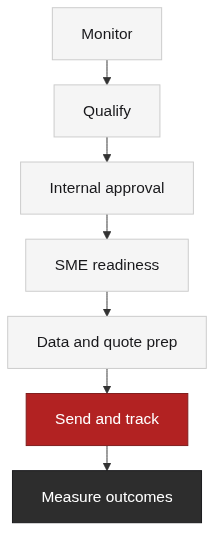
Reactive PR only works if the response path is pre-built. A six-step workflow turns a chaotic scramble into a repeatable process.
Monitor → qualify → internal approval → SME readiness → data/quote prep → send and track
- Monitor. Run media monitoring, trend tracking, and journalist-request platforms so opportunities surface early rather than late.
- Qualify. Run the opportunity through a fast qualification checklist (detailed in the next section) before committing resources.
- Internal approval. Route the response through a pre-set approval chain with clear authority levels so decisions do not bottleneck.
- SME readiness. Confirm that the named subject-matter expert is available within the window and authorized to comment.
- Data/quote prep. Pull from a maintained library of citable data points, standard quotes, and fact cards so the response is substantiated.
- Send and track. Send the response, follow up with the journalist, and log the outcome for measurement.
How to compress approval cycles with pre-set authority levels and named SMEs
The fastest way to slow down a Reactive PR response is an undefined approval process. Compress it by deciding in advance who can approve what: a pre-approved authority level for routine, low-risk commentary; a higher level for anything that touches a sensitive or controversial topic; and named, pre-briefed subject-matter experts who know they may be called on short notice. When the authority chain and expert roster are fixed before the opportunity appears, the approval step takes minutes instead of days.
The Speed–Accuracy–Brand Relevance triangle—sacrificing accuracy or relevance for speed is a losing trade
Reporters weigh relevance heavily when deciding which sources to use, and they respond faster to timely, current-news-aligned angles [3][4]. Every Reactive PR response is a balance of three constraints: Speed, Accuracy, and Brand Relevance. Speed gets you into the window. Accuracy keeps you credible and protects you from correction. Brand Relevance keeps the response on-message and worth citing. Sacrificing accuracy or relevance to be faster is a losing trade — a fast but wrong or off-brand response can damage the very trust that makes future citations possible. When you cannot satisfy all three, the disciplined move is to skip the opportunity.
Practical Application: The Opportunity Qualification Checklist and Evaluation Framework
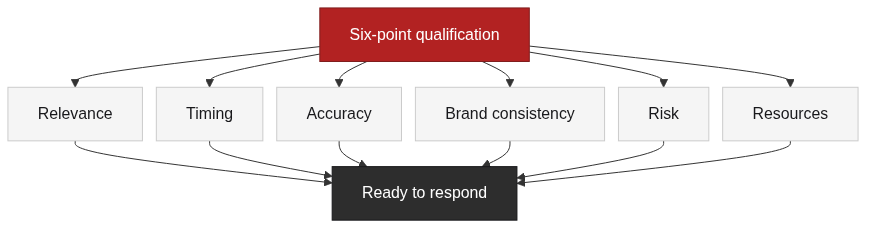
Reactive PR is not about responding to everything. It is about responding to the right things, fast, and declining the rest with confidence.
A six-point qualification checklist—relevance, timing, accuracy, brand consistency, risk, and resources—before committing to a response
Before investing in a response, run the opportunity through six checks. If any fails, reconsider:
- Relevance: Does this opportunity connect directly to the brand, business, or expert domain? Can we offer a credible, distinct viewpoint?
- Timing: Can we respond inside the effective window, or has the best moment already passed?
- Accuracy: Are the data and facts we plan to cite verifiable, and has the SME confirmed the viewpoint?
- Brand consistency: Does the response align with brand positioning, voice, and values, and does it avoid any brand red lines?
- Risk: Does the topic carry controversy, legal, or reputational risk, and has the stance been confirmed internally?
- Resources: Is the SME available, and is there capacity to complete approval and send within the window?
A pre-send self-check on speed, accuracy, and brand relevance; if any fails, skip the opportunity
Just before sending, run the Speed–Accuracy–Relevance triangle one more time. Is the response still inside the window? Are the facts verifiable and confirmed? Is the message genuinely on-brand and worth a reporter’s citation? If any of the three fails, the disciplined choice is to skip the opportunity rather than send a compromised response. A single off-brand or inaccurate response can cost more in trust than any one citation is worth.
How to measure outcomes—media citations, report visibility, natural backlinks, brand mention sentiment, and search/traffic impact
Reactive PR is only meaningful if you can measure what it produces. Track a set of outcomes that reflect both immediate visibility and longer-term value:
- Media citations: How many outlets quoted your expert or used your data.
- Report visibility: Whether the coverage appeared in the outlets your audience actually reads.
- Natural backlinks: The quality links that editorial coverage generates, which connect directly to Digital PR and link building goals.
- Brand mention sentiment: Whether the mentions are neutral, positive, or negative, and whether the coverage framed your brand accurately.
- Search and traffic impact: Whether the coverage drove referral traffic and contributed to search visibility over time.
Core Takeaways and Next Steps to Build Your Reactive PR System
Reactive PR rewards preparation over improvisation. The teams that win the window are not the ones that react fastest in the moment; they are the ones that were ready before the opportunity appeared.
The one-line summary—readiness, not reaction speed, is what separates teams that win the window
The difference between teams that consistently land citations and teams that miss them is not raw speed. It is readiness — having monitoring, approval, named experts, and citable assets in place before the next breaking story, trend, or journalist request arrives. Build the system first, and the speed follows.
A short action list to set up monitoring, approval, SME, and citable-asset readiness before the next opportunity
- Set up monitoring for your industry’s news, trends, and journalist-request platforms so opportunities surface early.
- Fix the approval chain with pre-set authority levels for routine and sensitive responses.
- Name your SMEs and brief them on the topics they may be asked to comment on and how quickly they may be called.
- Build a citable-asset library of verified data points, standard quotes, and fact cards your team can pull from instantly.
- Run a dry run — simulate a breaking story and time how long it takes your team to go from signal to send.
Connect Reactive PR to content-driven Digital PR and premium link building as a strategic partner
Reactive PR is a natural bridge into Digital PR and link building. Every strong citation from a fast, on-brand response is editorial coverage that can earn natural, quality backlinks — which is exactly what content-driven Digital PR is built to produce. If you want a partner who helps you turn reactive opportunities into sustainable visibility through compliant, content-driven premium link building, explore how TraffiClimb approaches Digital PR and link building as a strategic partner rather than a marketplace.
FAQ
References
- David Meerman Scott — Newsjacking — Source of the “newsjacking” concept popularized in his 2011 book of the same name, used to distinguish the tactic from Reactive PR as an overall method.
- Connectively (formerly HARO) — The journalist-request platform model, cited as the channel for explicit reporter information requests within Reactive PR.
- Cision — State of Journalism — Annual reporter survey that establishes relevance as the primary factor journalists weigh when deciding which pitches and sources to respond to.
- Muck Rack — Journalist research and blog — Reporter preference data and commentary that support the role of timeliness and current-news alignment in winning citations.
David Meerman Scott — Newsjacking: Source of the “newsjacking” concept popularized in his 2011 book of the same name, used to distinguish the tactic from Reactive PR as an overall method. https://www.davidmeermanscott.com/
Connectively (formerly HARO): The journalist-request platform model, cited as the channel for explicit reporter information requests within Reactive PR. https://www.connectively.us/
Cision — State of Journalism: Annual reporter survey that establishes relevance as the primary factor journalists weigh when deciding which pitches and sources to respond to. https://www.cision.com/resources/white-papers/state-of-journalism/
Muck Rack — Journalist research and blog: Reporter preference data and commentary that support the role of timeliness and current-news alignment in winning citations. https://muckrack.com/blog