
HARO & Journalist Outreach: How to Get Media Citations as an Expert Source
 Written by Sanja Gajic

HARO & Journalist Outreach used to be one of the most reliable ways for SEO professionals and link builders to earn editorial media citations. Then HARO (Help a Reporter Out) was retired by Cision in 2024, and its successor Connectively followed. A lot of people assumed the entire “journalist request” model died with it. It didn’t. What changed is the platforms and the rules—not the underlying opportunity to be quoted as a credible expert source.
This guide is a practical walkthrough of the journalist request model: how it works, how to judge which requests are worth your time, how to write a response that actually gets quoted, and which platforms to re-verify before you rely on them. It deliberately stays in scope: expert sourcing, relevance judgment, credible responses, and platform choices. It is not a full guide to media pitching, newsjacking, or reactive PR, and it makes no promise that answering a journalist’s request guarantees a link.
Why “HARO Is Dead” Misses the Point
The HARO shutdown myth
HARO (Help a Reporter Out) was retired by Cision in 2024, and its replacement product, Connectively, also stopped operating. If you search for “HARO” today, you will mostly find retrospectives and migration guides, not a live signup form. That much is true and widely documented [1][2].
The real shift
But the journalist request model itself never disappeared. A journalist still posts a query, experts still submit responses, and the journalist still picks the most useful lines to quote. What changed is the distribution: the platforms that host these queries, the pricing models, and the volume of competition. The opportunity to be cited as an expert source is as real as it was a decade ago—it just lives in a different set of tools now, and those tools need to be verified before you invest in them.
What this guide covers (and what it deliberately does not)
This guide covers the expert-sourcing side of HARO & Journalist Outreach: how to judge whether a request is relevant, how to structure a credible response, how fast you need to move, how to make a quote genuinely useful, and how to screen for quality and spam. It does not attempt to cover full media pitching, newsjacking, or reactive PR as complete strategies, and it will not tell you that answering a request automatically earns you a link. Editorial citations are earned, not guaranteed.
Understand the Journalist Request Model Before You Respond
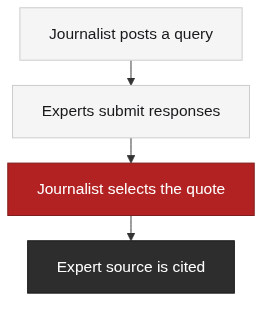
How the model works
The journalist request model is a three-step loop. A journalist publishes a query describing what they need (“I’m writing about link building spending for 2026 and need expert comment”). Experts and brand representatives submit written responses. The journalist then selects the most useful, quotable lines and attributes them to the named expert. Control sits with the journalist throughout—they choose the query, the deadline, and the quote.
Why this is “reverse outreach”
This is why the model is often described as reverse outreach. You are not pitching a story to a journalist who has no interest. You are responding to a journalist who has already signaled they want expert input. That changes the game: relevance judgment and response quality decide outcomes, not volume. Sending twenty generic, off-topic replies is actively worse than sending two well-targeted, substantive ones.
Where this model sits vs. media pitching, newsjacking, and reactive PR
It is worth being precise about boundaries. Media pitching is you initiating contact with a journalist to sell a story. Newsjacking is you inserting your brand into a breaking news moment. Reactive PR covers responding to journalists who reach out to you directly or to industry commentary you are part of. The journalist request model overlaps with the reactive side—you are responding to an explicit invitation—but it is distinct enough to treat on its own terms. That is the scope this guide stays inside.
Screen Every Request With a Relevance Filter
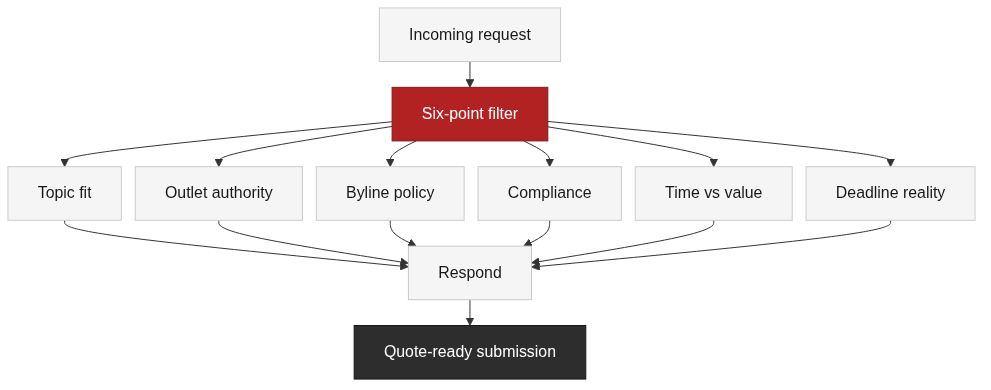
The 6-point relevance checklist
Not every request deserves a response. Before you spend time drafting a reply, run the request through a six-point filter:
- 1. Topic fit — Does the query fall inside your genuine expertise and the claims you can actually back up? If you cannot speak to it credibly, skip it.
- 2. Outlet authority — Is the journalist’s outlet reputable, and does it reach your target audience? A citation in a niche, respected outlet can be worth more than a throwaway line in a low-authority blog.
- 3. Byline and link policy — Does the outlet allow (or default to) a named byline and source link, or is it anonymous with no link? Know what you are actually earning.
- 4. Compliance red lines — Does responding conflict with your brand values, your compliance posture, or any legal risk? A quote you cannot stand behind is not worth the exposure.
- 5. Time versus value — A strong response takes effort. Is the potential citation value worth that time, or would your energy be better spent elsewhere?
- 6. Deadline reality — Is there enough time left to submit a quality response, or are you down to a few minutes where you would be forced to rush?
Quality and spam screening
Quality and spam screening works in both directions. Platforms screen out irrelevant or thin responses to protect journalists from noise, and you should screen out irrelevant requests to protect your own expert positioning. Responding to off-topic queries dilutes your credibility with the journalists who see your name attached to irrelevant commentary. Over time, that pattern can flag you as noise rather than as a source worth returning to.
The “rather skip than spam” rule
A rushed or irrelevant answer is worse than no answer, especially under a tight deadline. If you cannot offer a substantive, verifiable point in the time available, the professional move is to pass on the request entirely. Journalists remember sources who waste their time—and they remember sources who decline gracefully and come back strong on a better-fitting query.
Write a Credible Expert Response That Gets Quoted
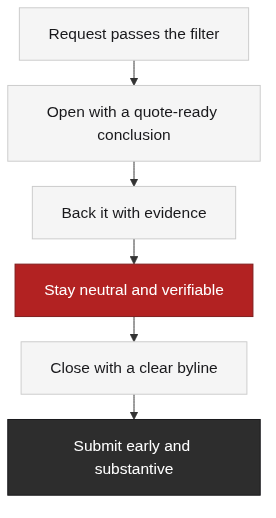
Response structure
A response that gets quoted follows a predictable structure:
- 1. Open with a quote-ready conclusion. Your first sentence should be a complete, standalone thought a journalist could lift and attribute directly. No throat-clearing, no “I think,” no brand preamble.
- 2. Back it with evidence. Support the conclusion with data, a specific case, or first-hand experience. Concrete beats generic every time.
- 3. Stay neutral and verifiable. Keep the tone measured and the claims checkable. Avoid overpromising and avoid attacking competitors.
- 4. Close with a clear byline. Give your name, title, organization, and a verifiable way to reach you. Journalists need to confirm who you are.
Speed versus quality
Speed matters because the window is short. Most journalist requests close within hours to a few days, and journalists tend to review submissions as they arrive, not just at the deadline. Responding early gives your quote a longer window to be seen. But speed never justifies thin content. The discipline is to move fast on the requests you have already screened as high-fit, and to pass on deadlines you cannot serve well. Fast and substantive beats fast and shallow.
Quote usefulness
Journalists choose quotes that are concise, opinionated, and directly embeddable. A useful quote states a clear point in one or two sentences, uses plain language, and avoids PR jargon and hedging. If your line reads like marketing copy, it gets cut. If it reads like an expert actually answering a question, it gets used. Piling on your brand name and stuffing links into the quote lowers your chances of being selected, because it makes the quote unusable as-is.
Choose the Right Platforms for HARO & Journalist Outreach
Freshness Gate check
Before you rely on any specific platform, run a Freshness Gate check. HARO and Connectively are confirmed retired, so any article or tool that still presents them as live is outdated. The journalist request landscape is volatile: platforms launch, pivot, and close. Verify the current operating status, pricing, positioning, and whether each platform still accepts new users before you commit time or money to it.
The current platform landscape to re-verify
The following platforms have historically been associated with the journalist request and expert sourcing model, and each should be re-verified for current status before you rely on it: Qwoted, Featured, SourceBottle, Help a B2B Writer, Muck Rack, ResponseSource (UK-focused), Pitchbox, and Cision’s journalist database. Do not assume any of these is active, correctly priced, or a good fit without checking the current details yourself. The model is stable; the specific vendors are not a fixed list.
Matching platform to business size
Your platform choice should match your operation:
- – Individual experts and small sites — Free or low-cost request platforms make sense when you are building a personal brand and want a small number of high-quality citations.
- – In-house SEO and marketing teams — Paid platforms plus a journalist database give you more volume and better filtering when you are pursuing editorial coverage as part of a broader strategy.
- – Digital agencies — Multi-platform coverage and white-label operations make sense when you are delivering editorial coverage for multiple clients at scale.
Practical Application: Build Your Expert Response Workflow
Scenario comparison: journalist request response vs. full media pitching
The two paths differ on every meaningful dimension, and knowing the difference keeps you from applying the wrong playbook.
| Comparison dimension | Journalist request response (this guide) | Full media pitching (out of scope here) |
|---|---|---|
| Trigger | Journalist posts a query, you respond | You initiate contact with the journalist |
| Control | Journalist leads selection, you are chosen | You lead, you follow up actively |
| Relevance judgment | Whether the query fits your expertise | Whether the outlet fits your audience |
| Content requirement | Quote-ready lines plus verifiable evidence | Full pitch, news angle, data story |
| Speed requirement | Strong time pressure, hours-long windows | Planned, no hard deadline |
| Link outcome | Journalist attributes a byline and source link | Link is negotiated, not guaranteed |
| Failure cost | Low — one unselected response | Higher — a rejected or ignored pitch |
The credible response writing checklist
Before you hit submit, run your draft through this checklist:
- – The first sentence is quote-ready and free of PR jargon.
- – The response is backed by specific data, a case, or first-hand experience.
- – The tone is neutral, verifiable, and free of overpromising.
- – The byline is complete: name, title, organization, verifiable contact.
- – There is no brand-name stacking, no link-stuffing, and no “guaranteed coverage” promise.
- – You are submitting early enough to avoid a rushed, thin answer.
Journalist relationship basics
A citation is the start of a relationship, not the end of one. After you are quoted, send a short, genuine thank-you. Follow up consistently on well-fitting requests so the journalist comes to recognize your name as a reliable source. Build trust over time by being accurate, on-time, and quotable. Avoid the common mistakes that burn relationships: over-promotional responses, irrelevant submissions, ignoring byline details, and promising coverage you cannot deliver.
Core Conclusion: Become the Expert Worth Quoting
The key takeaway
Journalist requests are an expert-sourcing game. Relevance, speed, and credible, quote-ready substance—not paid placement—win citations. The journalists who post these queries are looking for voices they can trust, and the ones who get quoted consistently are the ones who make selection easy for the journalist.
Your next steps
Start small and build a repeatable workflow. Audit your relevance filter against the six-point checklist. Draft a reusable response template with the quote-ready structure above. Verify the current status of the platforms you are considering before you invest time or money. Then begin with a small set of high-fit queries and refine based on what actually gets quoted.
Get a strategic partner
Earning editorial citations is one piece of a larger, compliant, content-driven link building strategy. If you want editorial coverage scaled across your SEO and digital PR goals—with transparent reporting and a partner who takes ownership—talk to the TraffiClimb team about a tailored plan. Your strategic partner for premium link building.
FAQ
References
Cision — Help a Reporter Out (HARO) retirement announcement — Cision, the company that owned HARO, announced and carried out the retirement of Help a Reporter Out in 2024, confirming the HARO shutdown and its successor Connectively.
Cision — Connectively platform information — Provides context on Connectively as HARO’s successor product, which also ceased operating, supporting the Freshness Gate requirement to re-verify current platforms.
Muck Rack — journalist database and request platform — A journalist database and query platform used for expert sourcing, listed among the platforms to re-verify before relying on them.
ResponseSource — journalist request platform (UK) — A UK-focused journalist request and expert sourcing platform, listed among the alternatives to verify for current operating status.