
Newsjacking: How to Turn Breaking News into Timely PR Story Angles
 Written by Sanja Gajic

A breaking story hits. Within the first 90 minutes, one brand publishes a short, sharply angled response and earns multiple media citations; a second brand waits until the next day, once the “wait-and-think” instinct settles, and finds the story has already cooled. The first responder captured an outsized share of attention. The second got nothing. That asymmetry is the entire case for newsjacking — and it is why timing, not polish, is the win condition.
Here is the counterintuitive truth that guides the rest of this guide: “fast enough but relevant” beats “perfect but late.” Speed earns you the window, but relevance and accuracy are the non-negotiable guardrails that keep you inside it. This guide walks you through how to spot a newsjacking moment, judge whether it genuinely fits your brand, craft a real angle, verify your facts under deadline pressure, and decide when to pitch versus when to step back.
The 24-Hour Window: Why Timing Decides Whether Your Story Gets Covered
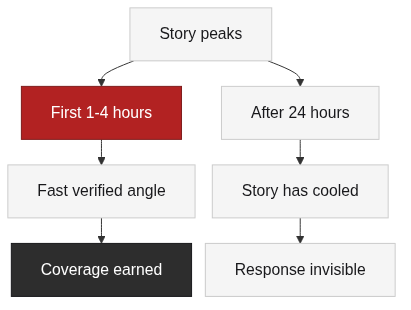
Picture the two brands again. In newsjacking, the 90-minute responder does not wait for a polished, multi-draft piece. It moves on a single fact-checked angle, publishes quickly, and becomes part of the conversation as it is still forming. The “wait-and-think” brand, by contrast, treats the news like an evergreen topic and produces a careful analysis a day later — by which point journalists have already filed their stories and moved on. The gap between them is not quality. It is timing [2].
Treat this as your operating principle: in news-driven PR, “fast enough but relevant” beats “perfect but late.” Speed is what gets your response into the window; relevance and accuracy are what keep it from damaging your credibility once it is there. A perfectly written piece that arrives too late is invisible. A fast, relevant, verified piece that arrives in the window has a real chance of being seen.
Here is what this guide covers: how to monitor trends and breaking news, judge whether a story genuinely relates to your audience, find an angle that adds value, layer in data and expert commentary, verify claims under time pressure, and evaluate whether to pitch now or downgrade to calmer commentary.
What Newsjacking Really Is — and Why Timing Is the Win Condition
Newsjacking is a specific, real-time tactic, not a vague social-media play. David Meerman Scott, who coined the term, defines it precisely:
“Newsjacking is the process by which you inject your ideas or angles into a breaking news story, in real-time, in order to generate media coverage for yourself or your business.” [1]
The definition carries three load-bearing words: inject, real-time, and coverage. You are adding a perspective to a story that already exists, while it is still being reported, in order to become part of the coverage. Nothing about that works if you arrive late.
Timing is the win condition because news has a brutally short freshness window. A breaking story’s search interest and media coverage collapse sharply within roughly 24 hours; the first responders capture a disproportionate share of the attention that remains [2]. After the window closes, the same content — however good — competes against an exhausted story that journalists have already covered and audiences have already consumed. In practice, this means the first few hours are where the opportunity lives, and the first 1 to 4 hours after a story peaks are the practical golden window for a pitch [2].
It is also worth drawing a clear boundary. Newsjacking is a subset of Reactive PR — the broader discipline that includes comment requests, expert responses, and reactive commentary. It is not a complete framework on its own, and it is not the same as generic social-media trend marketing. The distinction matters because it sets expectations: newsjacking is one tactical tool inside a larger reactive PR practice, with its own timing rules and its own risks.
Is This News Actually Relevant to You? Avoiding Forced Relevance
Before you draft a single line, run the story through a relevance test. The fastest way to damage a brand with newsjacking is to force a connection that does not exist. Apply what we call the three relevance questions:
- Audience: Does this story genuinely matter to your audience?
- Unique angle: Can your brand or team offer a perspective or data point others cannot?
- Context respect: Can you respond in a way that respects the event’s context — especially if it is a tragedy or sensitive situation?
If the answer to any of the three is no, disengage. The discipline of saying no is part of the skill.
The classic contrast illustrates why. During the 2013 Super Bowl blackout, Oreo published “Power out? No problem. You can still dunk in the dark” within minutes — fast, relevant, low-stakes, and perfectly matched to the moment. It became a textbook real-time marketing case because it added a light, brand-appropriate reaction to a benign event [3]. On the opposite end, brands that force marketing into disasters, natural catastrophes, or sensitive events generate backlash and are called out by media — not because their content was slow, but because it was tone-deaf [3].
The principle to internalize is relevance over speed. Not every news story warrants a response, and not every brand fits every story. The brands that succeed at newsjacking over time are the ones that decline most of the opportunities in front of them.
Finding a Real Angle and Adding Data or Expert Commentary
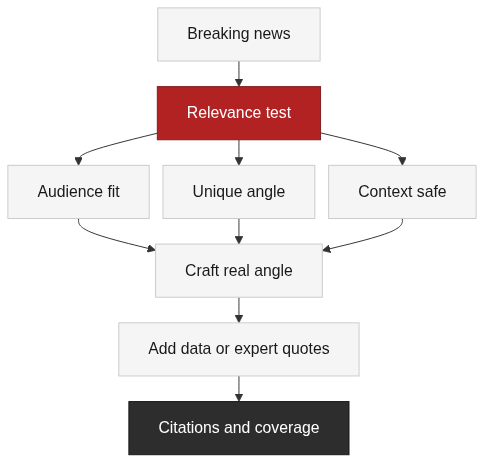
Once a story passes the relevance test, the work shifts from “should we respond?” to “what do we actually add?” The most common mistake at this stage is going brand-centric: leading with your product, your features, or your wins. That reads as self-promotion, and journalists ignore it.
Instead, build the angle from the audience’s or the industry’s perspective. Ask what the news means for the people you serve, and what your vantage point reveals that a general news report does not. A strong newsjacking angle answers a question the breaking story leaves open: what happens next, who is affected, or what the data behind the headline actually shows.
Then strengthen the response with evidence. Three additions reliably elevate a newsjacking piece from “jumping on a trend” to “providing value”:
- Industry data that contextualizes the story and gives it scale.
- Expert commentary or a named quote that adds authority and a quotable line for journalists.
- Your own case data or observations that offer a perspective no one else can replicate.
This evidence-led approach is what separates a real angle from a hot take. It is also where newsjacking connects to a content-driven, compliant positioning: a response that adds verifiable value is more likely to be cited, which is the objective mechanism that supports premium link building as an outcome — not a guarantee, but a consequence of being genuinely useful.
Speed vs Accuracy: How to Move Fast Without Tripping Compliance
The tension between speed and accuracy is the defining challenge of newsjacking, and the failure mode that causes the most damage is unverified information. Publishing a claim pulled from a headline, without checking the full context, can trigger a public-relations crisis that costs far more than any coverage the speed would have earned. Treat accuracy as the integrity-first red line: no matter how fast you want to be, you do not publish what you cannot verify [4].
Run every response through a pre-publish verification checklist before it goes out:
- Fact-check: Is every factual claim confirmed by at least one authoritative source?
- Full context: Do you understand the complete story, not just the headline?
- Legal and sensitive review: Does the response touch on legal, compliance, or sensitive territory?
- Brand-voice consistency: Does the tone match your brand’s personality — measured, not hype-driven?
- Value over hype: Does the piece provide value, or is it just riding the trend?
Speed works when it is applied to the distribution and the angle, not to the verification. Reserve the time for the checklist; a fast but wrong response is worse than a slightly slower correct one.
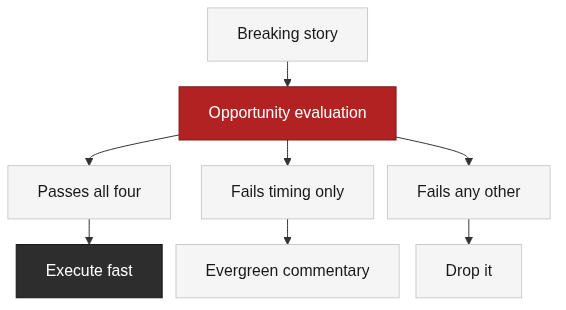
Two practical controls help you stay fast and safe. First, opportunity evaluation: before committing resources, ask whether the story is relevant, whether you have a unique angle, whether the context is safe, and whether you can realistically verify and publish within the peak window. If you cannot, either pass or downgrade. Second, pitch timing: the first 1 to 4 hours after a story peaks is the golden window for a pitch, but if you miss it, the smarter move is to downgrade to a calmer expert-commentary angle rather than forcing a late newsjacking attempt [2]. When you do pitch, lead with a quotable viewpoint plus data — that is far more likely to be picked up than a brand introduction.
Newsjacking vs Evergreen Content: Choosing Where to Spend Resources
Newsjacking and evergreen content are not competitors; they are different tools for different jobs, and understanding the trade-off keeps your content planning honest.
| Dimension | Newsjacking (riding the news) | Evergreen Content |
|---|---|---|
| Timeliness window | Hours to 24 hours | Months to years |
| Content cost | Low (single response / short piece) | High (long-form, in-depth) |
| Link / citation potential | Bursty and concentrated during the peak | Long-term and compounding |
| Failure risk | High (forced relevance, verification risk) | Low |
| Brand control | Low (constrained by the news context) | High |
| Best use | Brand awareness, real-time visibility | SEO rankings, authority building |
The decision path for any breaking story comes down to a handful of checkpoints. The table below contrasts the path that tends to succeed with the path that tends to fail:
| Decision point | Success path | Failure path |
|---|---|---|
| News selection | Relevant to audience, context-safe | Chases heat without checking relevance |
| Timing | Responds within the peak window | Waits until the story cools |
| Angle | Builds from audience or industry view | Hard-sells the brand and its features |
| Evidence | Adds data, expert quotes, case data | Empty slogans with no support |
| Verification | Fact, context, and sensitivity checks | Publishes unverified claims |
| Context | Respects the event, especially tragedies | Runs marketing inside disasters |
Use a short evaluation flow before committing any resources. For any breaking story, run the four-question opportunity evaluation — relevance, uniqueness, context safety, and your ability to verify and publish in time. If the story passes all four, execute fast. If it fails one, drop it. If it fails only the timing question, downgrade to evergreen commentary. That flow keeps your team from spending resources on the wrong moments.
Core Takeaways and Your Next Move
The principles behind good newsjacking are consistent, even as the news changes daily. Three of them matter most: relevance over speed, verification over hype, and value over trend-chasing. Speed earns the window; relevance, accuracy, and value are what let you keep it.
Equally important is knowing what to avoid. The common failure modes are all avoidable with discipline: forced relevance (forcing a connection that is not there), over-trending (responding to everything), sensitive-event exploitation (marketing inside tragedy), and unverified information (publishing what you cannot confirm). Get these right, and newsjacking becomes a reliable, low-cost addition to a broader Reactive PR practice — not a gamble.
If you are building a content and link-building strategy that rewards exactly this level of discipline, our team works with brands on content-driven, compliant approaches to earning visibility. Subscribe to our newsletter for ongoing PR and content-marketing insights, and explore how a strategic partner can help you turn well-crafted content into sustainable growth.
FAQ
References
David Meerman Scott — “Newsjacking: How to Inject Your Ideas into a Breaking News Story”: Provides the canonical definition of newsjacking quoted in this article. https://www.davidmeermanscott.com/blog/2011/11/newsjacking-how-to-inject-your-ideas-into-a-breaking-news-story.html
David Meerman Scott — Newsjacking book and public commentary: Provides the news freshness window and first-responder timing data used in the timing sections. https://www.davidmeermanscott.com/books/newsjacking/
AdAge — “Oreo’s Super Bowl Blackout Tweet Wins the Big Game”: Documents the Oreo “Dunk in the Dark” case and the contrast with tone-deaf real-time marketing. https://adage.com/article/digital/oreo-super-bowl-blackout-tweet-wins-big-game/242084
PRSA — Ethics and Accuracy in Public Relations Practice: Supports the integrity-first verification standard and the risk of publishing unverified information. https://www.prsa.org/ethics