
PBN Links: How Private Blog Networks Work and Why They’re Risky
 Written by Alistair MacLeod

If you’ve ever seen an outreach pitch that promises to “rebuild expired domains into a network of blogs” and push a competitive keyword up the rankings within months for a fraction of the cost of real editorial placements, you’ve just met the sales pitch for PBN links. The appeal is real, and so is the tension: a private blog network is attractive precisely because it looks like a shortcut, and it is dangerous precisely because it is one. This guide walks through how PBN links are produced, why the model seems appealing, the two-layer risk that makes it a losing long-term bet, and what to do instead.
Why PBN Links Look Like a Tempting Shortcut
The pitch is almost always the same. Buy an expired domain that once had real content and authority, rebuild it into a blog that looks established, place a link to your money site inside a post, and repeat across a handful of domains. In the short term, the numbers can look good, and the price is far below what a genuine editorial placement would cost.
The Core Contradiction
Here is the tension at the heart of the model: PBN links gain their appeal from being a shortcut, and they carry their risk for exactly the same reason. A private blog network works by concentrating ownership and injecting links artificially, which is the opposite of the editorial trust signal search engines are trying to measure. The same property that makes the approach quick and controllable is what makes it detectable.
What This Guide Covers
Before you decide whether PBN links are worth the risk, it helps to understand the mechanics first, then the two layers of long-term risk, and finally the sustainable alternatives. That is the order we’ll follow: how the network operates, why people use it, why it fails, and what replaces it.
What a Private Blog Network Is and How PBN Links Are Produced
A private blog network (PBN) is a group of websites controlled by a single operator that link to one another, and to a target site, in order to pass “authority.” The defining feature is not the number of sites but the fact that one party owns and controls them all.
Definition: One Owner, Many Sites
In a PBN, the owner has full control over every link: the anchor text, the placement on the page, the timing of publication, and the surrounding context. That total control is exactly what separates it from a real editorial link, which a third party grants because they judge your content to be worth citing. One is self-awarded; the other is earned.
The Production Chain
The way PBN links are generated follows a repeatable pattern:
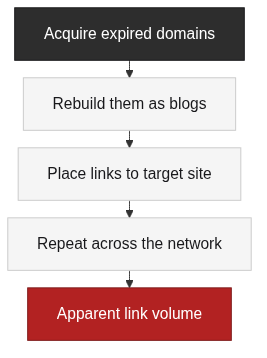
- Acquire expired domains — domains that once hosted content and accumulated historical authority.
- Rebuild them as blogs — restore a site that appears to have history and a normal publishing record.
- Place links to the target site — embed links inside the content to create the impression of natural editorial endorsement.
- Repeat across the network — scale the same process across multiple domains to build apparent link volume.
Typical Network Structure
A common structure is one “money site” (the target you want to rank) supported by multiple PBN sites that act as authority sources. Those PBN sites may also interlink with each other, which can compound the problem: when several controlled domains link to each other and to the same target, the shared ownership pattern becomes part of the footprint.
Why Expired Domains and Ownership Are the Heart of the Model
Expired domains are central to how a private blog network works, and they are also central to why the model leaves traces. Understanding this mechanism helps you evaluate any link-building proposal that leans heavily on “historical domains.”
What an Expired Domain Is
An expired domain is an old domain name that once had content and, potentially, real links and authority. When someone lets a domain lapse, it can be re-registered by a new owner. In a PBN, the operator buys the domain and rebuilds it so that, on the surface, it looks like a site with a genuine history. That surface “trust signal” is what makes the early network look authoritative.
Ownership and Control
Because the operator owns the domain outright, they control the anchor text, the link placement, the publication date, and the content around the link. This is the fundamental difference from a real editorial link. In a genuine editorial placement, the publisher decides whether and how to link. In a PBN, the operator decides everything — which is precisely the signal search engines are looking for when they evaluate link intent.
The Core Weakness
The combination of ownership transfer plus content rebuild is exactly the pattern that algorithm and human review are designed to catch. The historical authority of the domain may look real, but the editorial judgment behind the link is not. The model borrows trust it did not earn, and that borrowed trust is the structural weakness.
Why People Use PBNs — The Appeal, Explained Neutrally
It is worth being honest about why the model persists. For a site owner in a competitive niche, PBN links can feel like the difference between waiting months for organic traction and getting it quickly. Understanding the appeal is not an endorsement — it is context for a fair risk evaluation.
Control, Scale, and Speed
From the operator’s perspective, a PBN offers the illusion of full control. Every variable — anchor text, placement, timing — is managed by one party. That control can make the approach feel scalable and repeatable in a way that genuine outreach rarely is. For a niche where earning natural links is slow and uncertain, the “certainty” of a PBN has a genuine pull.
Surface Authority From Expired Domains
The expired-domain foundation gives early PBN links a surface authority that can be convincing. A domain with a real backlink history looks, at a glance, like a trusted source. That surface signal is what makes the network appear legitimate in its early days, before the pattern becomes visible.
The Certainty Factor in Competitive Niches
In industries where competitors are aggressive and content alone rarely earns links, the deterministic nature of a PBN is tempting. You place the link, you control the anchor, you know it’s live. That certainty is the psychological appeal — and it is also the trap, because the same determinism is what leaves a repeatable fingerprint.
> Boundary note: This section explains why the model is appealing. It does not provide instructions for building, buying, or hiding a private blog network. The purpose here is risk education, not a how-to.
The Two-Layer Risk: Footprints and Artificial Editorial Signals
The long-term risk of PBN links is not a single failure point. It is two layers of mechanism, both actively working against the model. Understanding both layers is essential to a fair evaluation.
Footprints: Scaling Leaves Traces
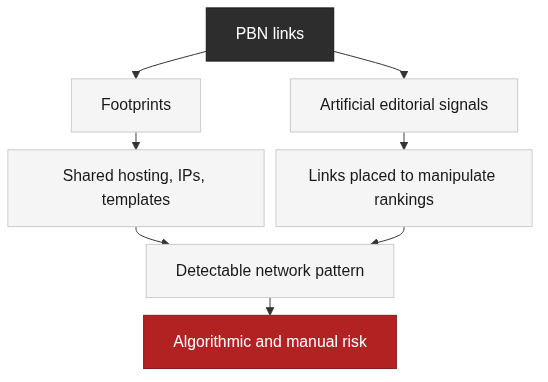
Footprints are the shared characteristics that a network of PBN sites exposes because of how they are operated. To control costs, operators often reuse the same registrar, hosting, IP ranges, or templates across sites. Anchor text can become overly concentrated, content updates can stall, and the sites typically show no real user signals. These shared traits form a recognizable fingerprint. The more sites you scale, the more obvious the reuse becomes — which is why scaling a PBN tends to make it easier to identify, not harder.
Artificial Editorial Signals
A PBN manufactures what looks like an editorial signal, but it is artificial. The link is placed by the owner for the purpose of manipulating rankings, not granted by a publisher who judged the content valuable. In terms of ownership and intent, an artificial editorial signal is fundamentally different from a real one — and intent is the core of how link schemes are defined. This is why the risk is not about the quality of the page. The problem is that the link violates the intent requirement for a natural editorial endorsement.
Why Scaling Compounds the Pattern
Because operators reuse infrastructure to keep costs down, the shared traits across the network become the fingerprint that can be identified. The scaling that makes the approach attractive is the same scaling that makes it detectable. A handful of sites might be harder to spot; a large network built on reused infrastructure leaves a pattern that is far more visible.
Algorithm Risks and Manual Actions — Why Failure Can Be Sudden
The risk of PBN links is not “maybe you’ll get caught.” It is that both algorithm and human review mechanisms actively target the pattern. When failure comes, it tends to be sudden, broad, and hard to recover from.
Algorithm-Level Risk
Search engines have repeatedly refined how they detect and neutralize link manipulation, including networks built on expired domains. A link spam update or core update can identify and discount these links automatically. When that happens, the “authority” a PBN was meant to pass can be ignored entirely — or, worse, treated as a negative signal. This is not a one-time event; the pattern is continuously reviewed as systems evolve.
Manual Action Risk
If a network is identified and confirmed to violate link policies, a site can receive a manual action. A manual action is a site-level penalty that requires a formal reconsideration request, with evidence of cleanup, before rankings can recover. The recovery cost is high, and the outcome is not guaranteed. Unlike an algorithm adjustment, a manual action is a documented, site-wide consequence that can set a project back significantly.
The Key Point: Double-Layer Exposure
The decisive point is that PBN links face two active layers of risk at once — algorithmic and manual. Because both mechanisms are designed to catch the pattern, failure is rarely gradual. It tends to be sudden, large-scale, and difficult to reverse. For a business that depends on organic traffic, that kind of downside is hard to justify against the short-term upside.
PBN Links vs. Real Editorial Backlinks — A Side-by-Side Comparison
The clearest way to evaluate the trade-off is to put PBN links next to genuine editorial backlinks across the dimensions that matter most.
| Dimension | PBN links (Private Blog Network) | Real editorial backlinks |
|---|---|---|
| Ownership | One operator controls all sites (self-awarded) | Third-party sites grant links voluntarily (earned) |
| Link intent | Injected artificially to manipulate rankings | Granted naturally because the content has value |
| Trust source | Expired domain + rebuilt content (surface only) | Real history, real traffic, real editorial judgment |
| Anchor text | Operator-controlled, often over-optimized | Naturally varied, decided by the publisher |
| Scalability | Appears batch-repeatable | Depends on real content and relationships, hard to mass-produce |
| Algorithm stance | Violates link scheme policy; actively targeted | Complies with policy; a positive ranking signal |
| Failure mode | Sudden, site-wide, hard to recover | Long-term stable, persists with content quality |
| Long-term value | Short-term gain, then zero or negative | Compounds with brand growth over time |
A Checklist for Spotting Suspect PBN Links
If you’re evaluating a link source, run it against this checklist. Hitting any of these should raise a red flag:
- Ownership / Whois association: Many sites share the same operator, registrar, or contact details.
- Infrastructure reuse: Sites share hosting, IP ranges, or templates.
- Content quality drop-off: High-authority-looking domains host thin or generic content.
- Concentrated anchor text: The same over-optimized anchors appear across many links.
- No real external signals: No genuine backlinks, social presence, or traffic to the domain.
- Artificial context: The link appears in a page that is clearly built around the link, not around value for readers.
A Decision Framework
Before sending money to any “quick way to get lots of links,” self-check each proposal against these questions. If you answer “yes” to ownership, artificial intent, expired-domain reliance, or policy non-compliance, that is a red light — regardless of how well the network is hidden. The nature of a PBN (concentrated ownership plus artificial injection) sits inside the red zone by definition, and hiding it does not change what it is.
More Sustainable Alternatives — and the Core Conclusion
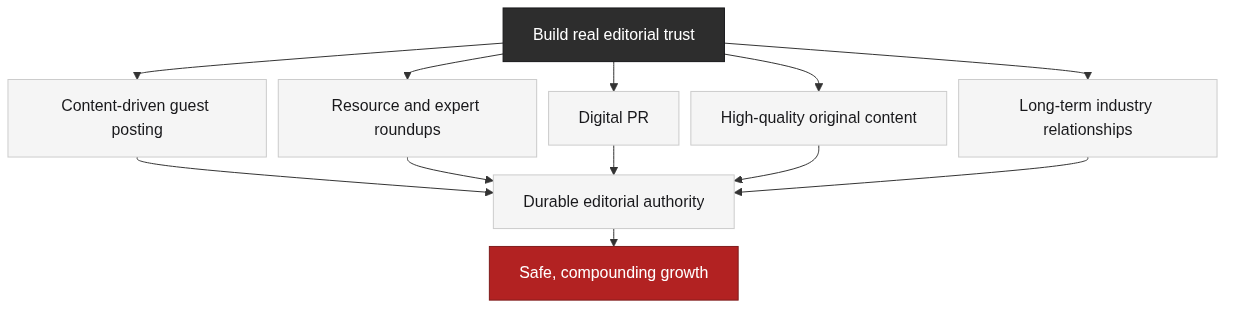
The honest takeaway is that PBN links are a short-term shortcut with a long-term downside that can wipe out the gains. The alternative is not glamorous, but it is durable: build real editorial trust signals through content and relationships.
Sustainable Paths
- Content-driven guest posting on genuinely relevant, authoritative sites where you earn placement through value.
- Resource and expert roundups that others cite because they are genuinely useful.
- Digital PR — data-driven research and reports that media outlets reference organically.
- High-quality original content that earns natural editorial links because it answers real questions.
- Long-term relationships with industry authorities that can scale sustainably over time.
These paths align with a compliance-first, content-driven approach to link building — the same direction the broader market is moving as shortcut-based link tactics lose value.
The Core Conclusion
PBN links are a short-term shortcut that tends to return to zero — or worse — over the long term. Real editorial trust signals cannot be manufactured; they have to be earned through genuine content and relationships. The moment you stop asking “should I use a PBN?” and start asking “how do I earn real editorial links sustainably?” is the moment you stop gambling with your rankings.
Your Next Step
If you’re weighing a link-building proposal and aren’t sure whether it’s safe, or you want a compliant, content-driven strategy that builds authority you can keep, talk to our team about a sustainable link-building plan built around real editorial trust — not shortcuts.
FAQ
References
Google Search Central — Spam policies — Documents how link schemes and purchased links are defined as spam, the policy framework that classifies PBN links as manipulation.
Google Search Central — Manual actions — Explains the site-level manual action mechanism, the penalty types, and the reconsideration process.
Google Search Central blog — The official channel where link spam updates and core update changes to link-quality evaluation are announced.
Ahrefs Blog — Publishes public analyses of PBN footprints, including infrastructure reuse, anchor text concentration, and content-stall patterns.
Search Engine Journal — Covers industry discussion of private blog networks, footprint detection, and the editorial-vs-artificial link distinction.